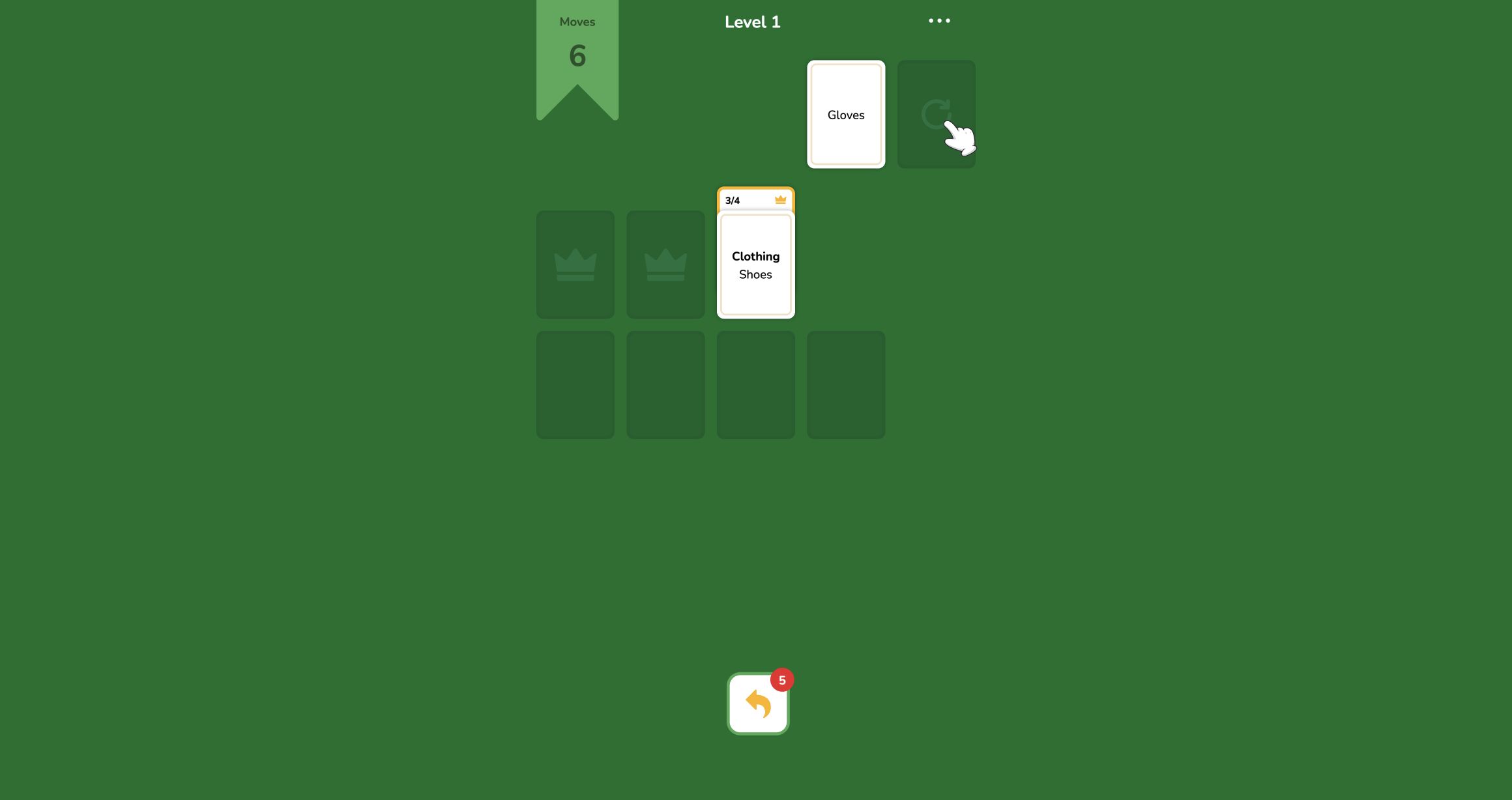
Five moves survived my first complete category sort
My first Word Solitaire result was a clean Victory, but the route there was more deliberate than the relaxed green table suggests. Level 1 began with 24 moves and three category targets: Hobbies needed five related words, Art needed three, and Clothing needed four. I finished every stack with five moves left. The completed result panel offered Next Level, but I stopped there, so this review covers one full level rather than making claims about later layouts or difficulty.
The successful groups were specific. Dancing, Gaming, Singing, Hiking and Cooking completed Hobbies. Drawing, Sketch and Mosaic completed Art. Hat, Socks, Shoes and Gloves completed Clothing. Those words did not arrive in one convenient list. Several were buried under other cards, while Hiking, Shoes, Cooking and Gloves came from the blue stock at the upper right. Solving the board meant exposing useful cards, opening categories in the crown slots, and spending draws without exhausting the move ribbon.
I played a complete Level 1 in desktop Chrome. The catalog also declares Android and iOS support, but I could not complete a comparable run in Playflaming's mobile fullscreen player. I therefore make no touch-control or best-device claim.
The opening tableau teaches its rule through exposure
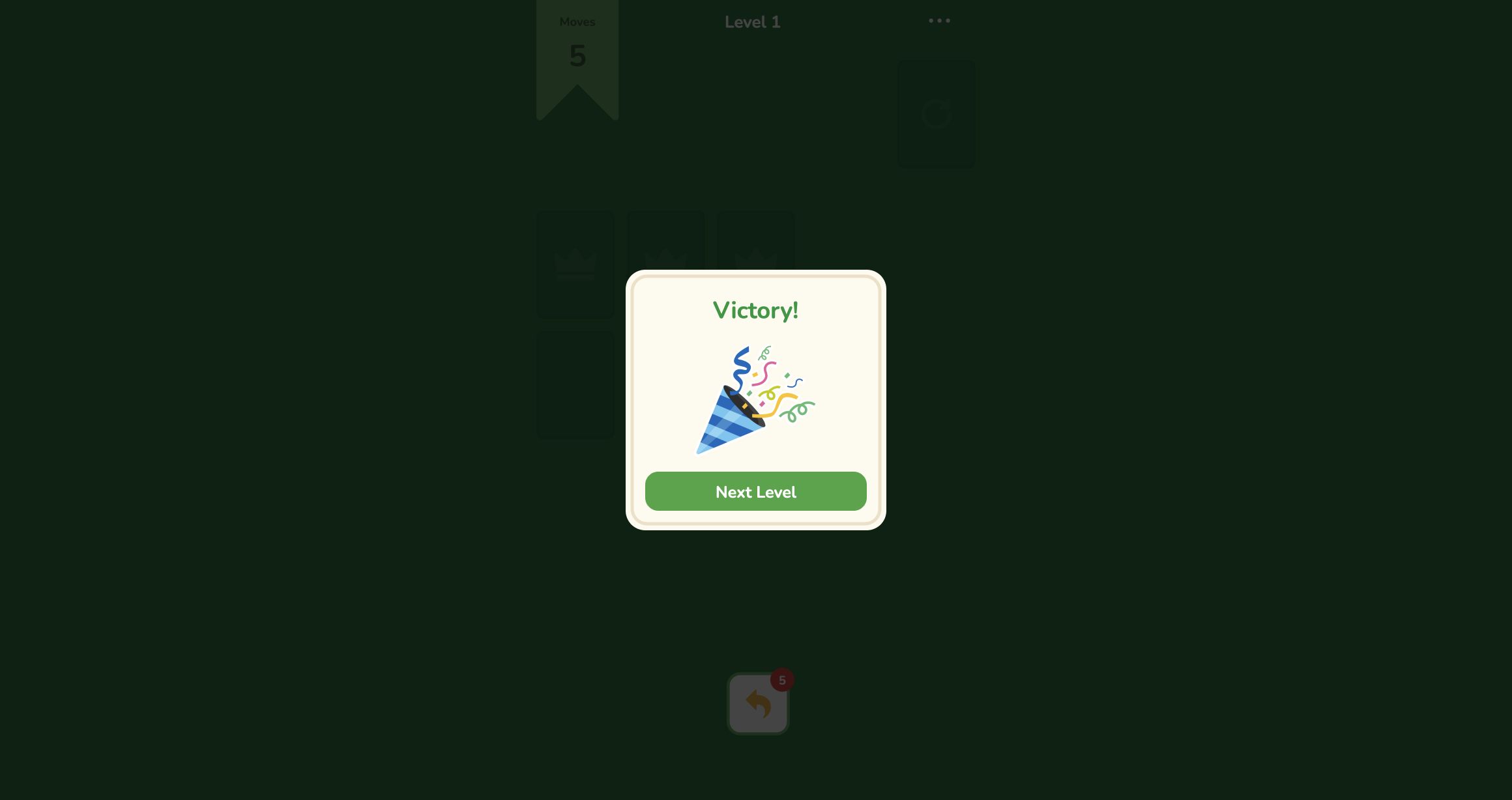
The board borrows solitaire's layered-card rhythm without borrowing suits or descending numbers. Four face-up columns sat below three dark crown spaces. Hobbies, Art and Clothing were category cards with counters printed in their corners; Drawing was an ordinary word card. Blue card backs behind the face-up cards promised more information, and a separate stock waited above them. The objective became readable before any long tutorial: move category cards to the crown row, then feed each one words that belong to it.
Dragging Hobbies into the first crown slot cost one move and exposed Dancing beneath it. Moving Art and Clothing into the remaining targets opened two more columns for sorting. This is the central pleasure of the game. A correct placement does more than increase a category counter; it often uncovers the next decision. The board gradually stops looking like four unrelated piles and starts behaving like a small dependency puzzle.
Controls were direct but demanded a real drag. Clicking a card and then clicking a destination did not move it during my session. Pressing on the face-up card, holding through the path and releasing over the intended stack worked consistently. The generous card rectangles made precise aiming easy in the wide player, although the requirement to drag is worth learning immediately.
Three open categories turned vocabulary into planning
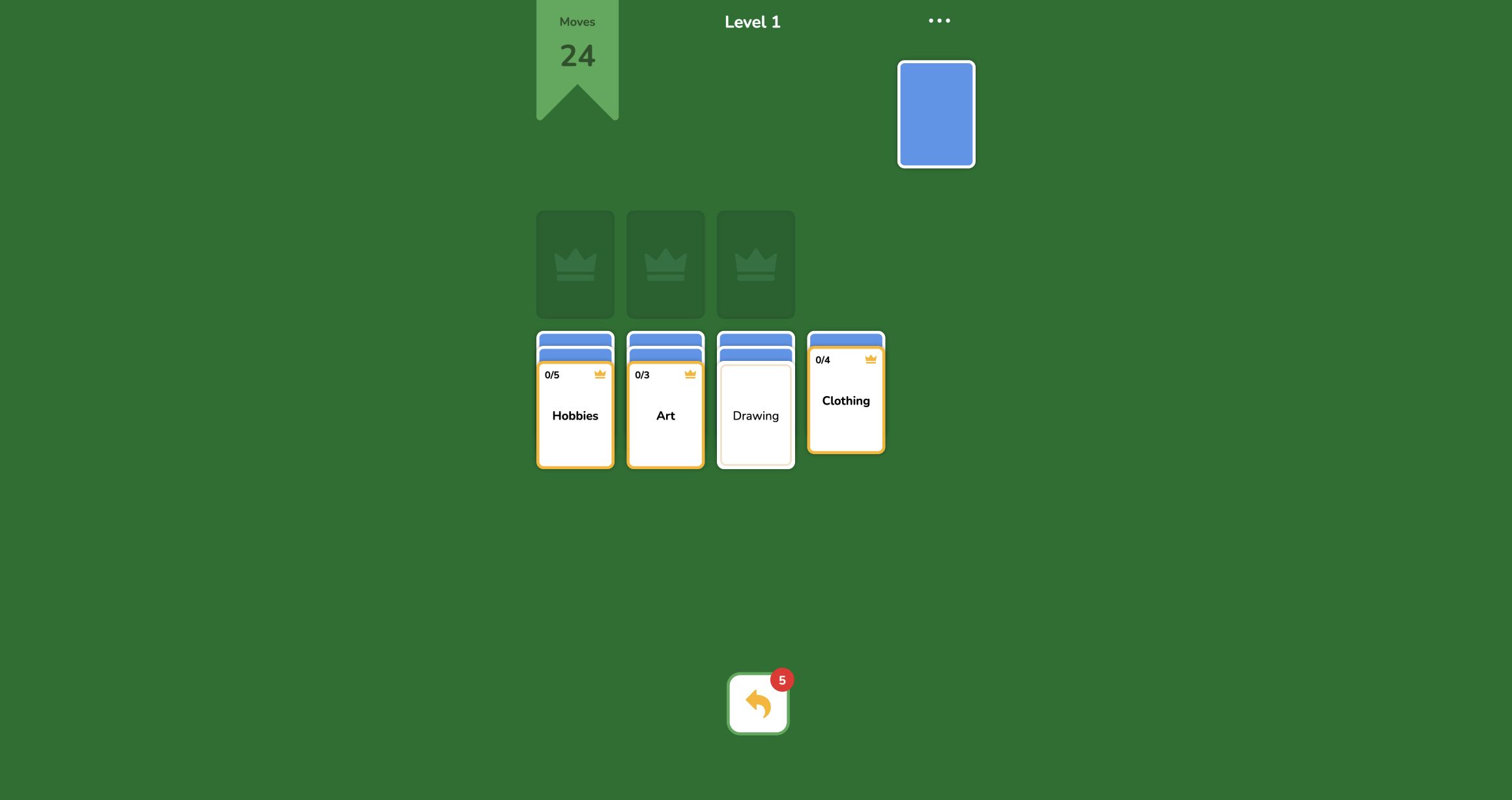
Once the top row held Hobbies, Art and Clothing, the puzzle stopped being about finding somewhere legal and became about choosing a useful order. Dancing went to Hobbies first. That revealed Gaming, while other columns exposed Singing, Drawing and Hat. Gaming and Singing were straightforward hobby matches, Hat clearly belonged with Clothing, and Drawing fitted Art in the level's intended grouping even though it could plausibly be called a hobby in ordinary conversation.
That last ambiguity is important. Word Solitaire is not asking whether an association is defensible; it is checking its authored category set. The printed counters help reveal that structure. Art requires exactly three cards, while Hobbies takes five, so Sketch and Mosaic later make Drawing's intended home much clearer. The challenge is therefore part vocabulary and part deduction from the level's inventory.
After those four placements, the board showed Hobbies at 3/5, Art at 1/3 and Clothing at 1/4, with 16 moves left. The numbers gave me a useful planning snapshot. Hobbies was already more than half complete, yet Art and Clothing still controlled which buried columns had to be cleared. There was no timer pushing me to act, so I could compare the exposed words before committing a drag.
A wrong category snapped back without taking a move
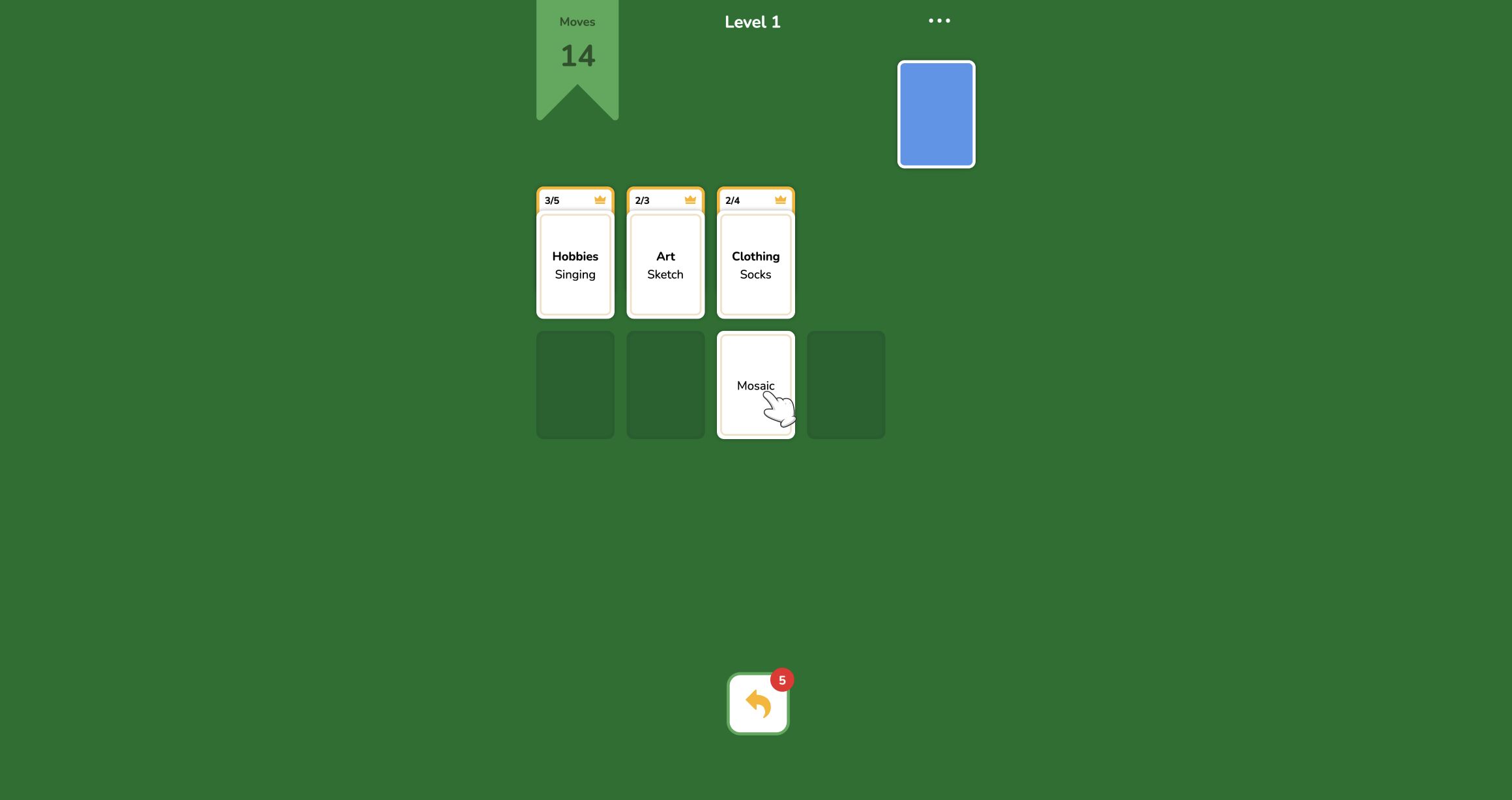
My deliberate mistake came with Mosaic. Art was sitting at 2/3 after Drawing and Sketch, while Clothing was at 2/4 after Hat and Socks. I dragged Mosaic to Clothing anyway. The card snapped back to its column, neither counter changed, and the move ribbon remained at 14. The game did not flash a life loss, add a strike or spend a move simply for testing an incorrect association.
That forgiving rejection keeps the puzzle approachable. You still need to preserve moves for accepted placements and stock draws, but a semantic uncertainty does not automatically ruin the run. Moving Mosaic to Art on the next attempt completed the 3/3 stack and removed it from the active board, making the remaining two goals easier to read.
An undo button was visible near the bottom with a red badge showing five, but I did not use it. I cannot say whether the badge represented five free undos, a consumable count or something else. The wrong drop was enough to establish the safer beginner lesson: if a word is ambiguous, a rejected category attempt can be corrected without spending the displayed move allowance in this opening level.
The stock made every late answer cost two decisions
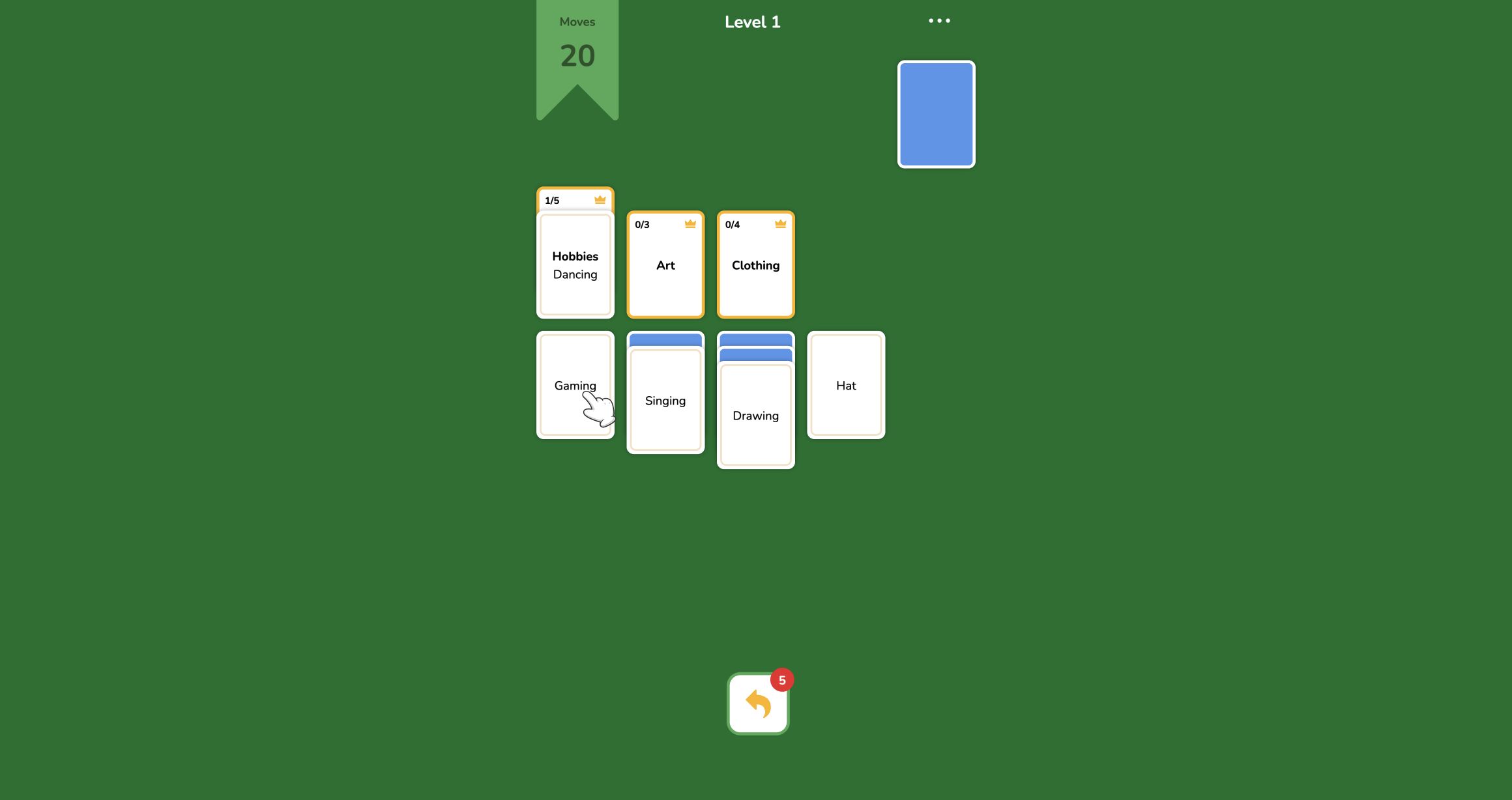
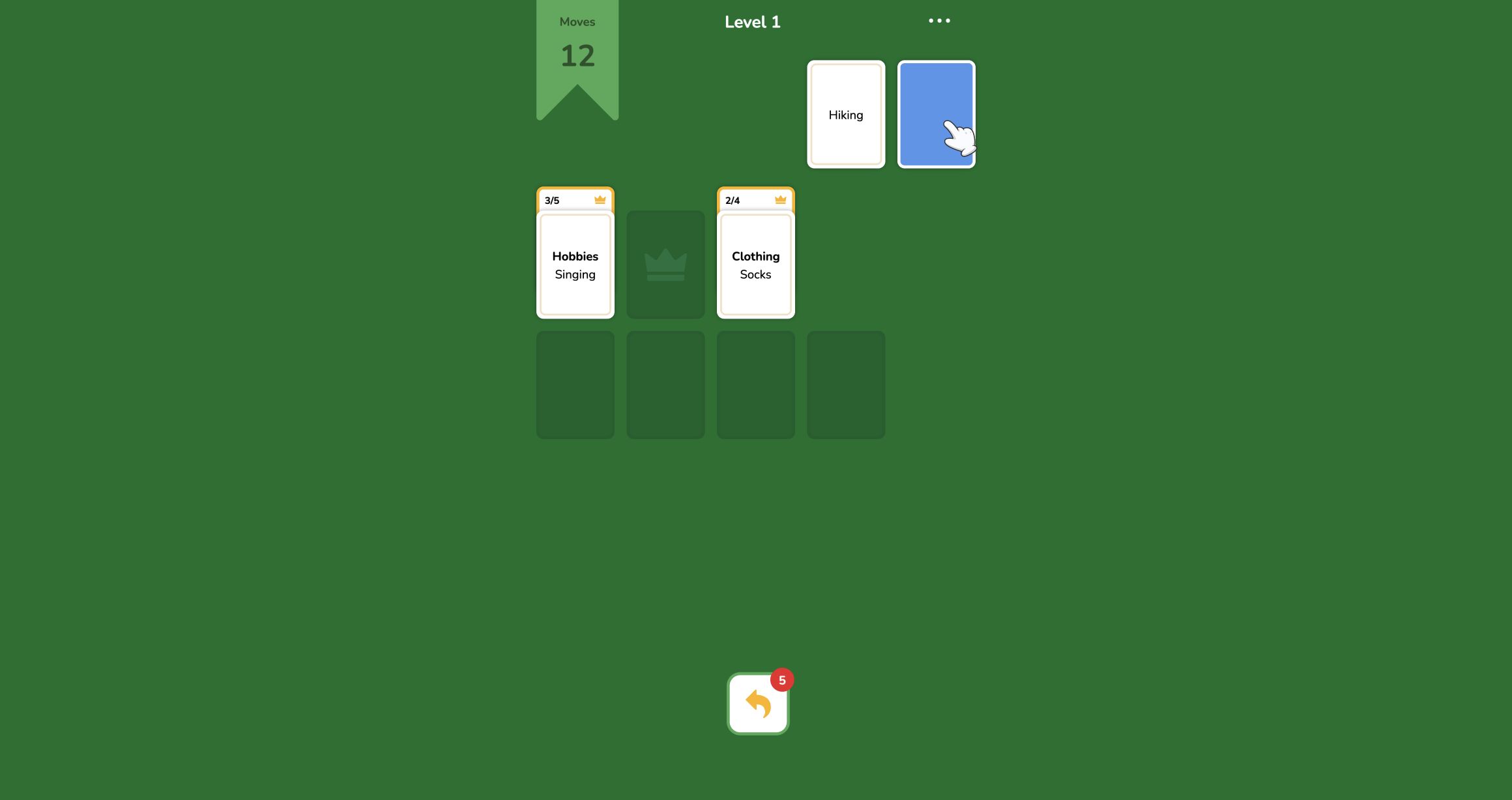
Clearing the tableau did not finish the level because the last four answers were in the stock. Clicking the blue deck revealed Hiking and reduced the move count; dragging Hiking to Hobbies consumed another move. The next draws were Shoes, Cooking and Gloves. Each needed the same two-step rhythm: spend a move to expose the word, then spend another to place it.
That arithmetic explains why the opening 24 is not as generous as it first looks. Category setup uses three moves, twelve words need twelve accepted placements, and four stock reveals use four more. The intended clean route totals 19 moves, matching my five remaining at Victory. My wrong Mosaic drop did not disturb that total. The level is therefore tightly constructed even though the surface feels casual.
The late categories also close cleanly. Cooking took Hobbies to 5/5 and removed that stack, leaving only Clothing. Gloves appeared as the final stock card with six moves left. Dropping it onto Clothing produced the Victory panel at five. The shrinking top row gave stronger progress feedback than an abstract score would have done.
The pleasure is in watching three stacks disappear
Word Solitaire will suit players who like sorting, lightweight deduction and vocabulary puzzles without a clock. Its best idea is not merely replacing suits with words; it is tying semantic matches to layered-card exposure and a visible move budget. The first level is readable enough for a beginner, yet Drawing's overlap between Art and Hobbies hints at how later boards could create genuine uncertainty.
The presentation is spare. I saw no login prompt, chat, username, purchase offer or advertisement during the completed desktop loop. I also did not enter the options menu, use undo, start Level 2 or reach the zero-move failure state. Those features and outcomes remain unknown rather than being filled in from assumptions or catalog copy.
Within the verified boundary, the strongest advice is to open category cards before spending stock draws, use the printed totals to resolve ambiguous associations, and remember that every stock answer costs one move to reveal and another to place. The result is a small but coherent puzzle: three groups, twelve words, nineteen necessary actions and a Victory that accurately reflected the route I played.