Tile Farm Story opened with characters—and an unexpected language barrier
My desktop session did not begin on a bare puzzle grid. After I skipped the opening cinematic, Tile Farm Story showed a dialogue log over a soft-focus country property, with alternating portraits labeled Бритни and Оливия—Britney and Olivia. The conversation, the green continue control, and every later tutorial message were rendered in Russian automatically. I did not find or test a language selector, so I cannot say whether English was available elsewhere in the game. What I can say is that this direct-export session started in Russian despite the catalog listing only en-US.
That localization mismatch was the main startup friction. The large portraits and alternating speech boxes made the scene's structure easy to follow, but a player who cannot read Russian will miss the details that are supposed to connect the sisters to the farm setting. I continued because the puzzle tutorial communicates heavily through pictures and simple placement. No account prompt, purchase screen, or mandatory ad interrupted the tested opening, and I did not click any external or monetized control. The story premise was visible; its exact narrative meaning remained outside what this English-language play session could verify.

The first board reduces the rule to twelve readable tiles
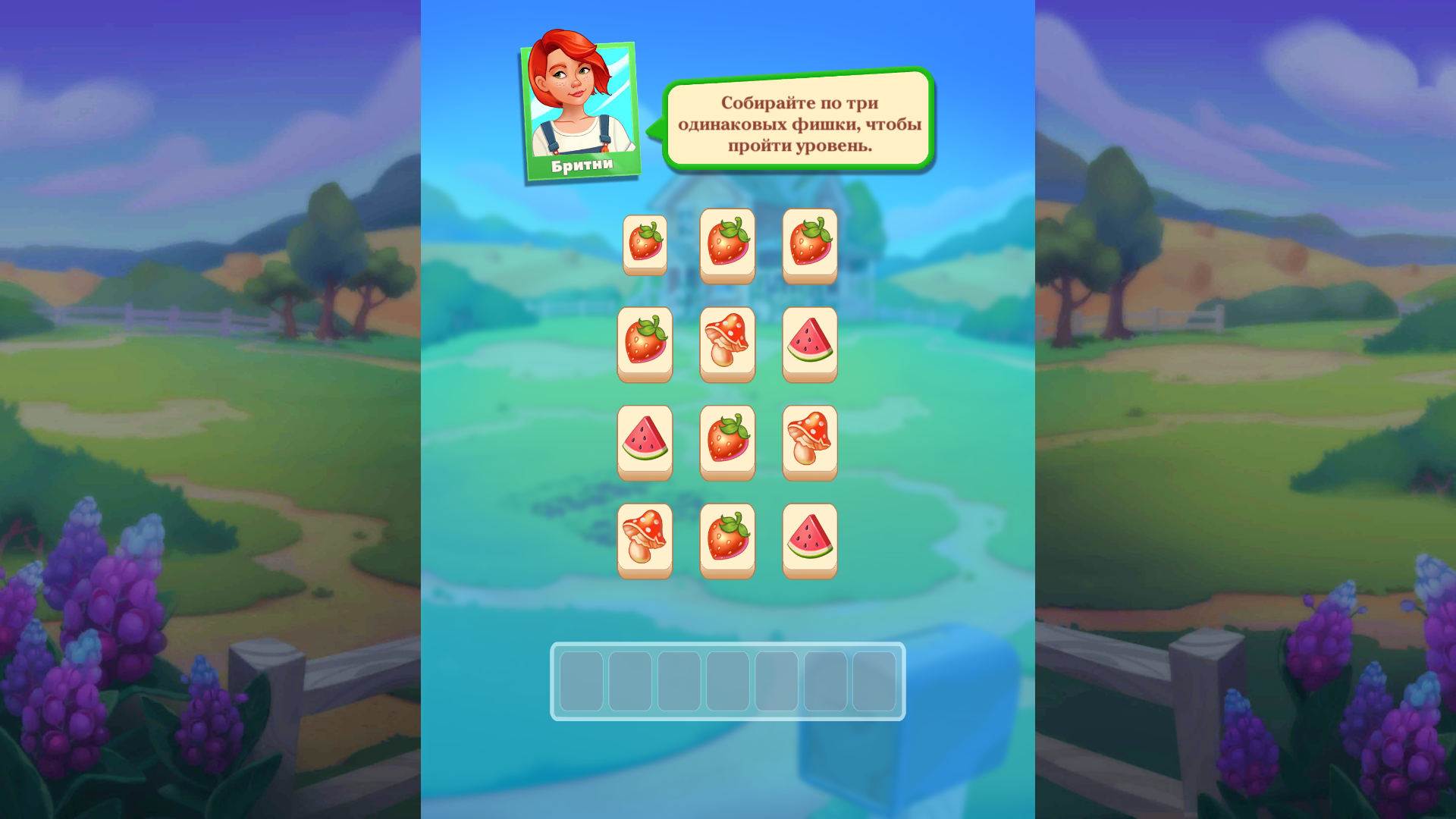
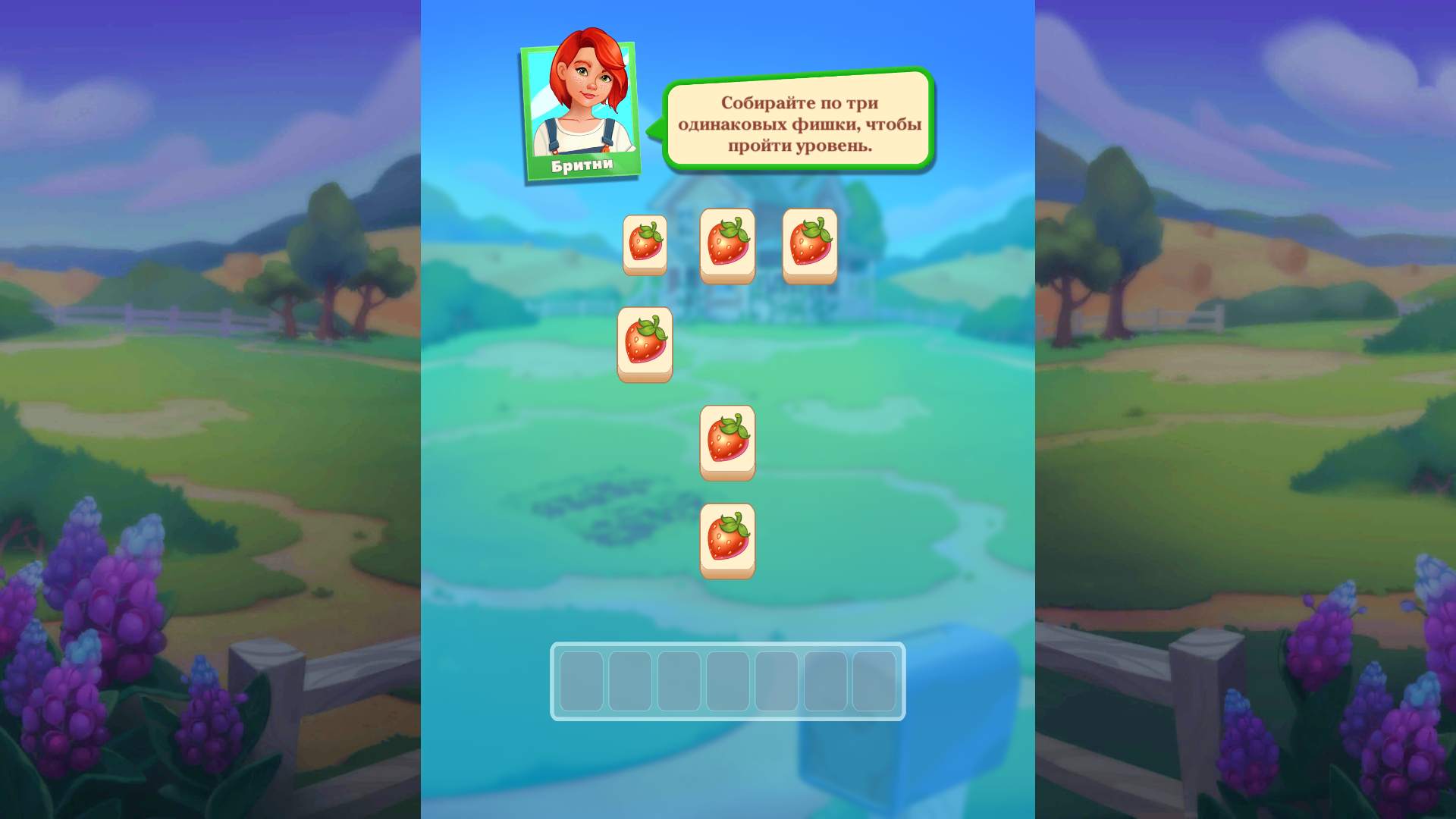
The tutorial board was deliberately small: twelve face-up tiles arranged in a three-column portrait play area. I counted three watermelons, three red-and-white mushrooms, and six strawberries. Seven outlined holding cells sat below them. Unlike a layered mahjong-style layout with covered pieces, every symbol in this first exercise was visible and selectable from the start. That made the intended solution transparent even without translating every word of the speech bubble.
The portrait composition also stood out on desktop. The active board occupied a tall central strip while blurred farm scenery filled the left and right sides of the 1280x720 capture. Symbols remained large and easy to distinguish: watermelon used a red triangular slice, mushrooms had spotted caps, and strawberries filled most of their cream tile. This was an onboarding puzzle rather than a serious capacity test. Its purpose was to establish the select-three rhythm, show where chosen tiles wait, and connect each completed set to an immediate reward animation.
Two watermelons demonstrate why the tray is temporary storage
I started with watermelon. The first two slices moved into the left side of the holding row and stayed there, occupying separate cells. The Russian instruction above the board remained visible beside Britney's portrait, while the third watermelon waited in the grid. Selecting that final slice completed the family. The three tiles broke apart in a bright effect and the tray returned to empty, confirming the basic rule through cause and effect rather than requiring an English explanation.
This tiny sequence teaches a useful habit for later boards. Two matching symbols are only a commitment; the tray space comes back after the third arrives. On this tutorial layout there was no reason to mix types because all three watermelons were exposed. A more complicated stack could make that decision risky, but the first puzzle keeps the lesson controlled. I never approached the seven-cell limit, triggered a fail state, or needed a booster, so this review does not pretend the opening level proves how forgiving later puzzles will be.
Every completed triple flashed a visible +3 coin response
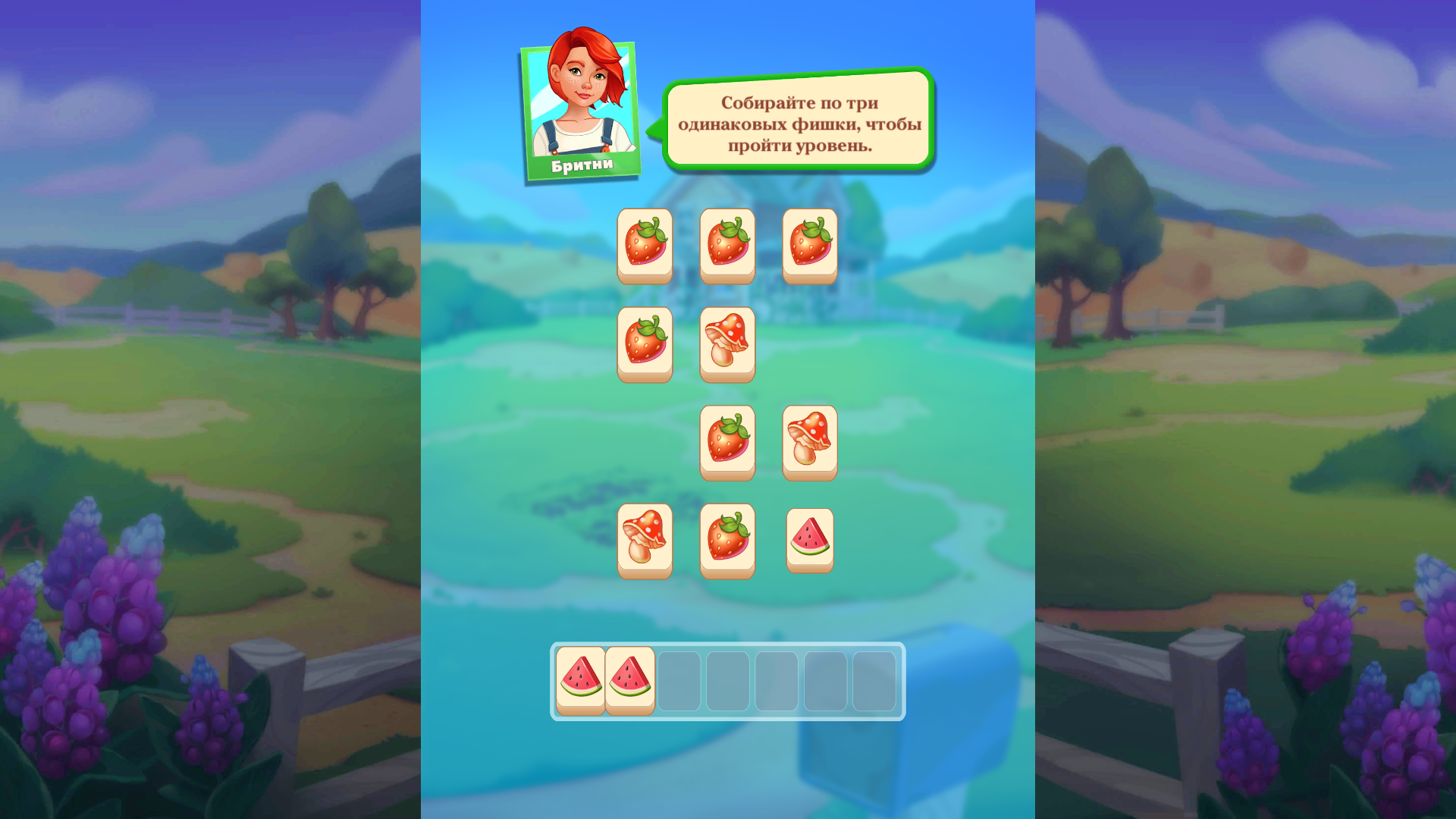
The watermelon match did more than remove tiles. A small +3 coin indicator appeared above the clearing animation. I then selected the three mushrooms and saw the same feedback again. The board shrank cleanly after each set, leaving only strawberries. Because each triple was worth three in the visible feedback, the reward math stayed easy to audit: four total triples should produce twelve, provided the final result counted every match in the same way.
That consistent response was the most satisfying part of the short loop. A selection clicks into the tray, the third match triggers a burst, and the empty cells are immediately ready for another family. There was no score combo, timer, or precision challenge visible in this tutorial. The reward came from completing a known set correctly. Players who enjoy calm sorting will understand the appeal quickly, though experienced matching-game fans should expect this first board to teach rather than test them. The interesting difficulty will have to come from later layers, obstacles, or tighter tray management, none of which I claim to have reached here.
Six strawberries turn one obvious group into two separate matches
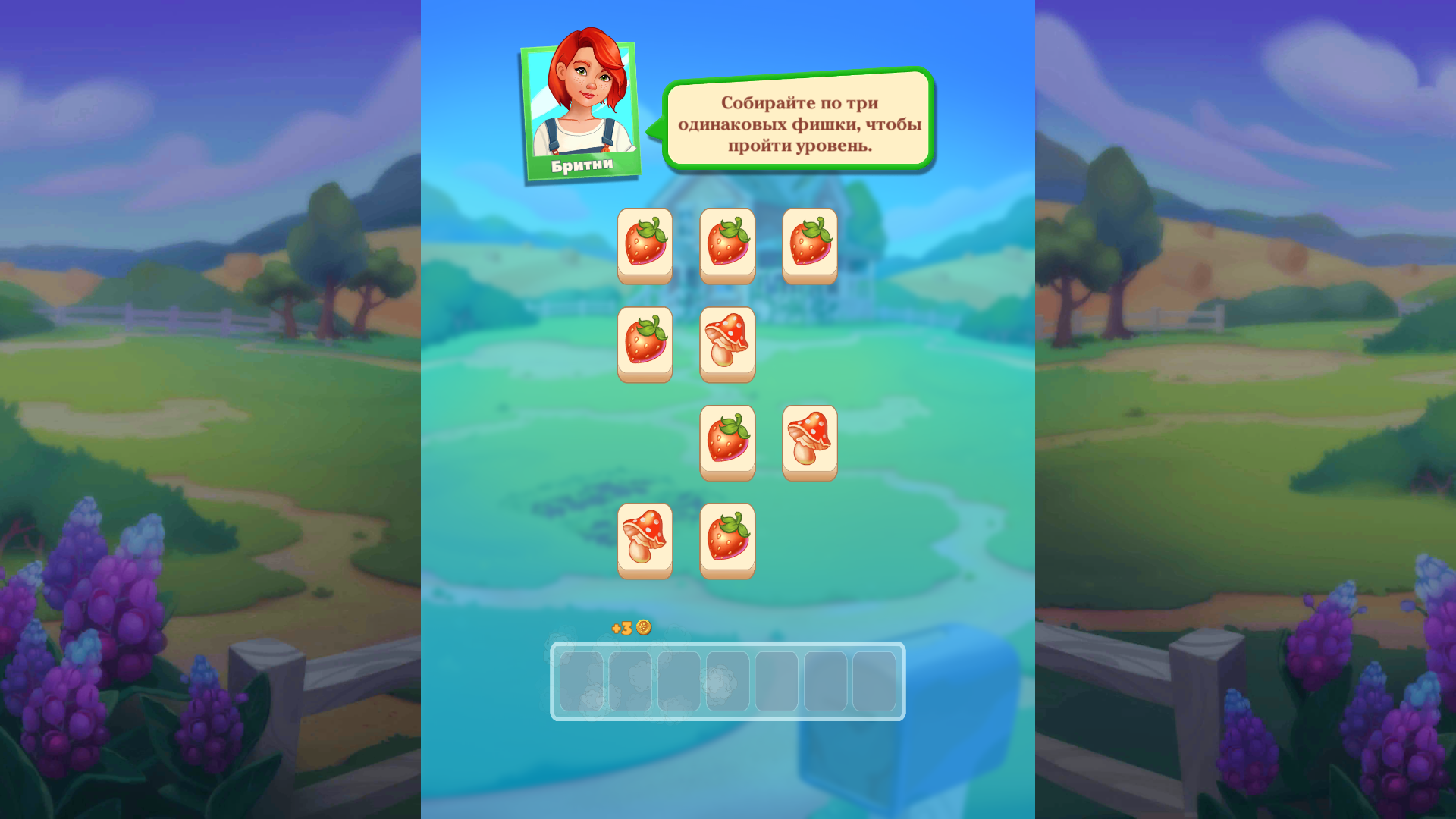
After watermelon and mushrooms disappeared, six strawberries remained in a loose vertical arrangement. They were identical, but the game still processed them as two groups of three rather than one six-tile action. I clicked the first three, watched the +3 response clear the tray, then repeated the same sequence with the final three. The order inside each strawberry group did not matter because all six tiles were equally exposed and no other symbol remained to compete for space.
This final step made the tutorial's accounting especially clear. The board began with twelve tiles and ended after four triples: watermelon, mushroom, strawberry, strawberry. At no point did I have to guess whether a shaded tile was selectable or whether one image differed subtly from another. That clarity is welcoming, but it also means the opening gives little evidence about strategy. The best beginner advice for this exact board is simply to finish one visible symbol family before starting the next. It keeps the tray empty and lets the +3 feedback confirm each completed group.
The Russian Excellent screen closed the loop at exactly 12 coins
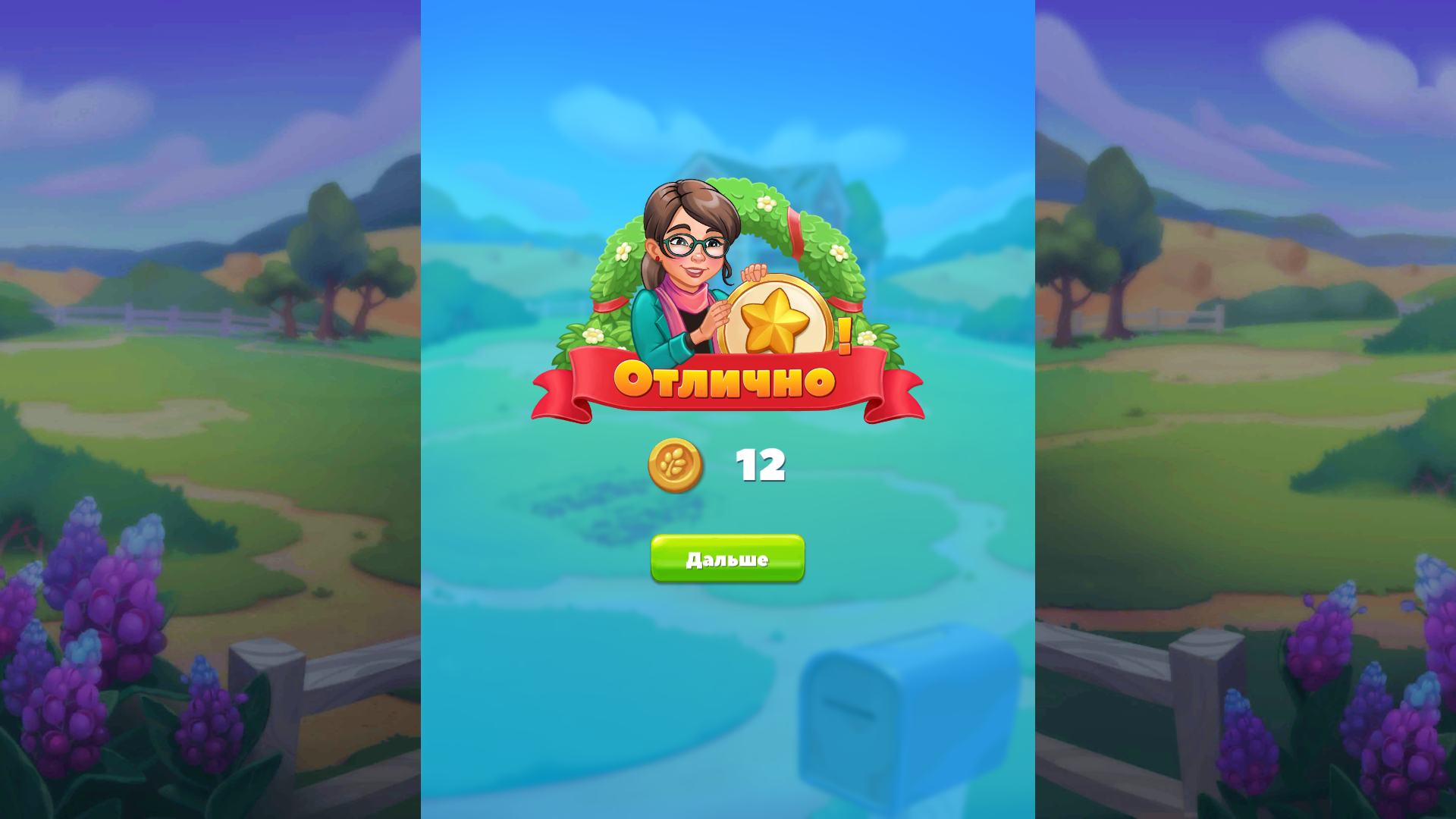
Clearing the last strawberry triple produced the promised result. Olivia appeared holding a star medal above the Russian word Отлично!, meaning Excellent. A coin emblem and the number 12 sat beneath the banner, matching the four visible +3 events exactly, and a green Дальше—Next—button offered to continue. I stopped there rather than turning an introductory clear into claims about later farm restoration, boosters, animals, or story twists that this session had not reached.
Tile Farm Story's first puzzle is an approachable, visually tidy introduction to triple matching, and its concrete 12-coin finish gives the short loop a real endpoint. The reservation is equally concrete: the tested direct export auto-localized its story, instructions, and result into Russian, with no language menu verified. That will be minor for players reading Russian and substantial for those who came for the character story in English.
I also opened the local Tile Farm Story detail route at a 390x844 layout viewport and tapped Play. Playflaming's fullscreen modal appeared with its back control and bottom game label, and the provider's Let's Play! gate loaded correctly. After I pressed it, the player remained black except for the surrounding modal chrome and Tile Farm Story label for roughly 35–45 seconds; a recovery attempt reached the same state. These two true 390x844 PNGs record the blocker at CSS resolution, not mobile gameplay or high-DPR phone pixels. Since no comparable touch puzzle loop loaded, I make no touch-response, physical-phone performance, or best-device claim.
