A city sprint that exposed the timer before the traffic
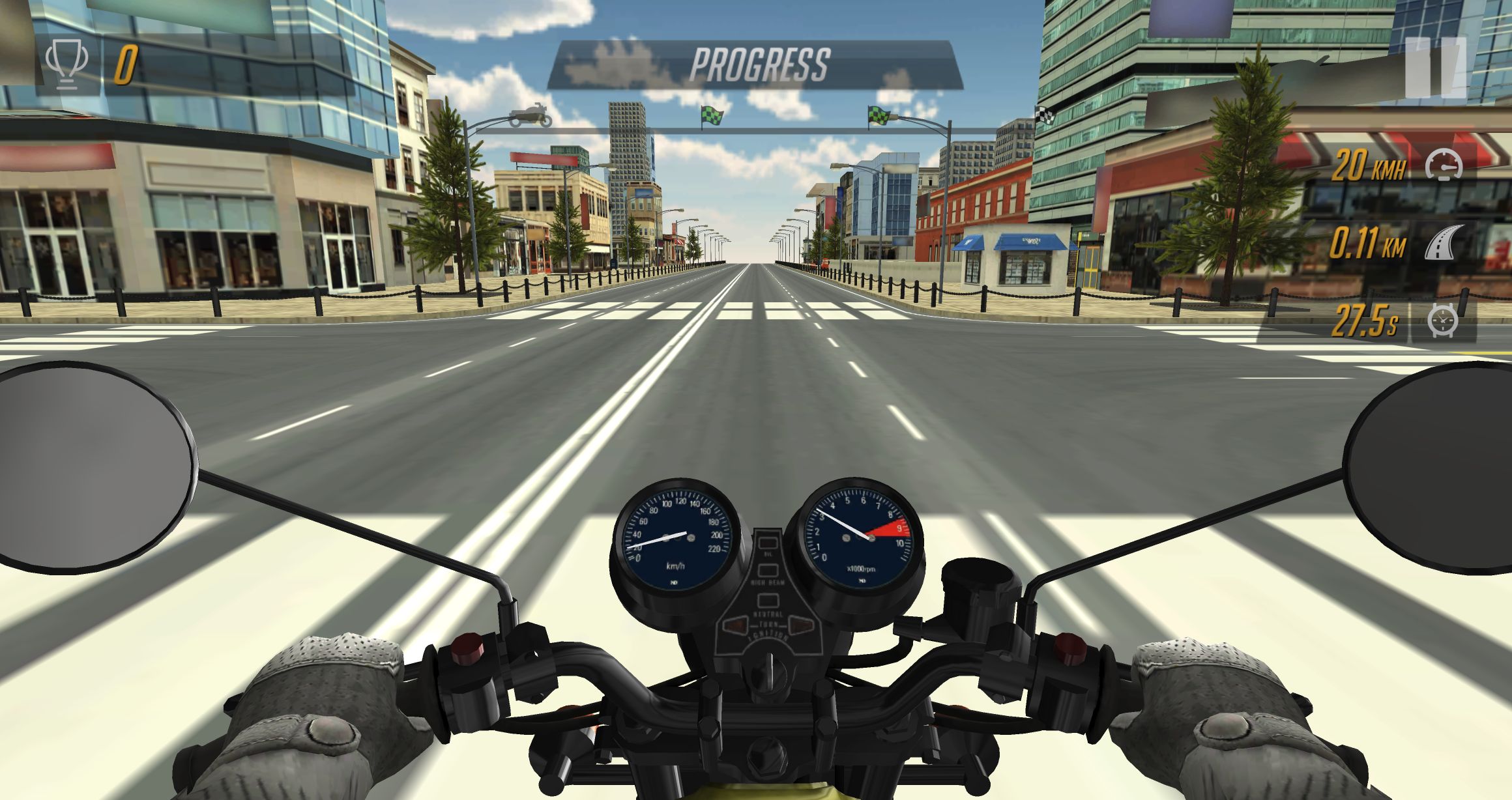
My clearest Motorcycle Racer: Road Mayhem run was not a victory lap. The direct full-screen desktop capture shows Career Mission 1 at 0.11 KM with 27.5 seconds left, followed by another frame at 0.25 KM with 10.7 seconds left. The avenue ahead was broad and almost unnervingly empty: glass office blocks, older storefronts, traffic lights, lane markings, and roadside chains streamed past a cockpit framed by mirrors, gloves, and twin analogue gauges. That complete HUD made the problem obvious. I was moving, but not quickly enough to beat the mission clock.
The fresh 2320 by 1228 desktop run and the comparable run inside Playflaming's 390 by 844 mobile fullscreen modal both reached a result screen and ended with Time Is Up. Desktop stopped at 0.33 total distance and mobile reached 0.37. I never reached the finish, passed another vehicle, triggered a crash, or unlocked a later mission, so none of those events are treated as if they happened. The appeal I could verify is the sensation of sitting behind a chunky old motorcycle on a bright city road, paired with a strict first objective that immediately demands better speed management than my short inputs produced.
The direct desktop player also made the road evidence much easier to read than an embedded page would have. The entire game viewport stayed visible at once, including both gauges, the timer, distance, progress bar, mirrors, and roadside scene. That matters for this review because the published frame is the original 2320 by 1228 game output, not a game rectangle cut from a larger detail-page screenshot.

The CX 750F menu promises progression, with ads close at hand
Getting to that road involved more ceremony than the simple racing premise suggests. The local Playflaming page first opened a Playgama panel with its own Let's Play button. A timed ad appeared, followed by a separate ad with a visible Close control, and Unity still needed another loading interval. I closed only the ad control and never clicked the creative. Later menu transitions also produced brief Playgama ad overlays. The friction is real enough that a quick retry can feel less quick than it should.
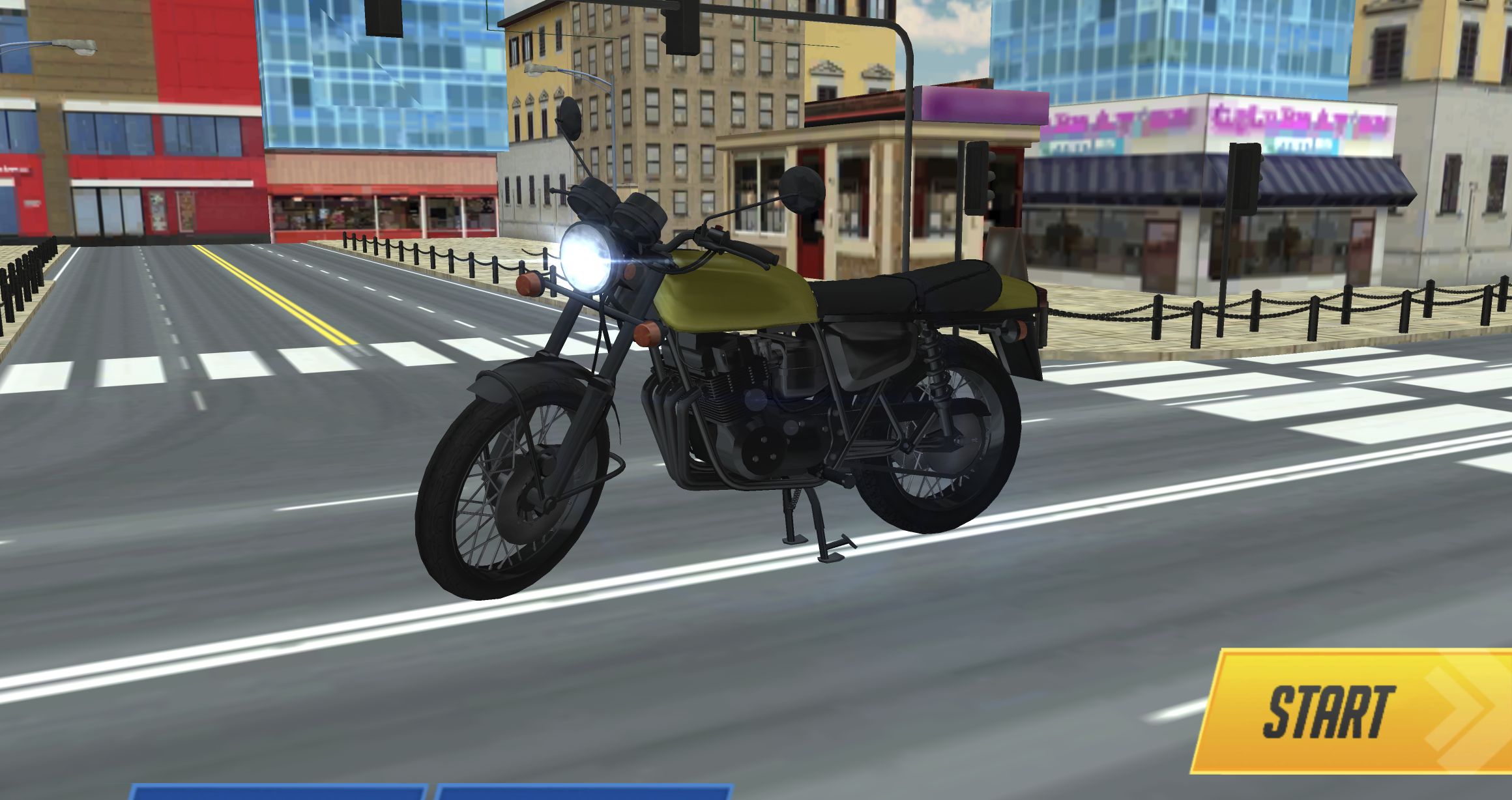
The game itself then presented a Day 1 bonus worth 1 G. I took that bonus, saw the tile change to Taken, and arrived at the main menu. The unbranded bike is called CX 750F, and the three large options are Daily Rewards, Garage, and Start. An ad icon beside a +1,000 $ offer is visible at the top, but I left it alone. I also saw no cash price, checkout, purchase form, loot box, or spin. What the session did establish is an ad-supported progression shell with two displayed currencies, a garage, daily rewards, and optional ad-labelled benefits.
Career is only one of four visible ways to ride
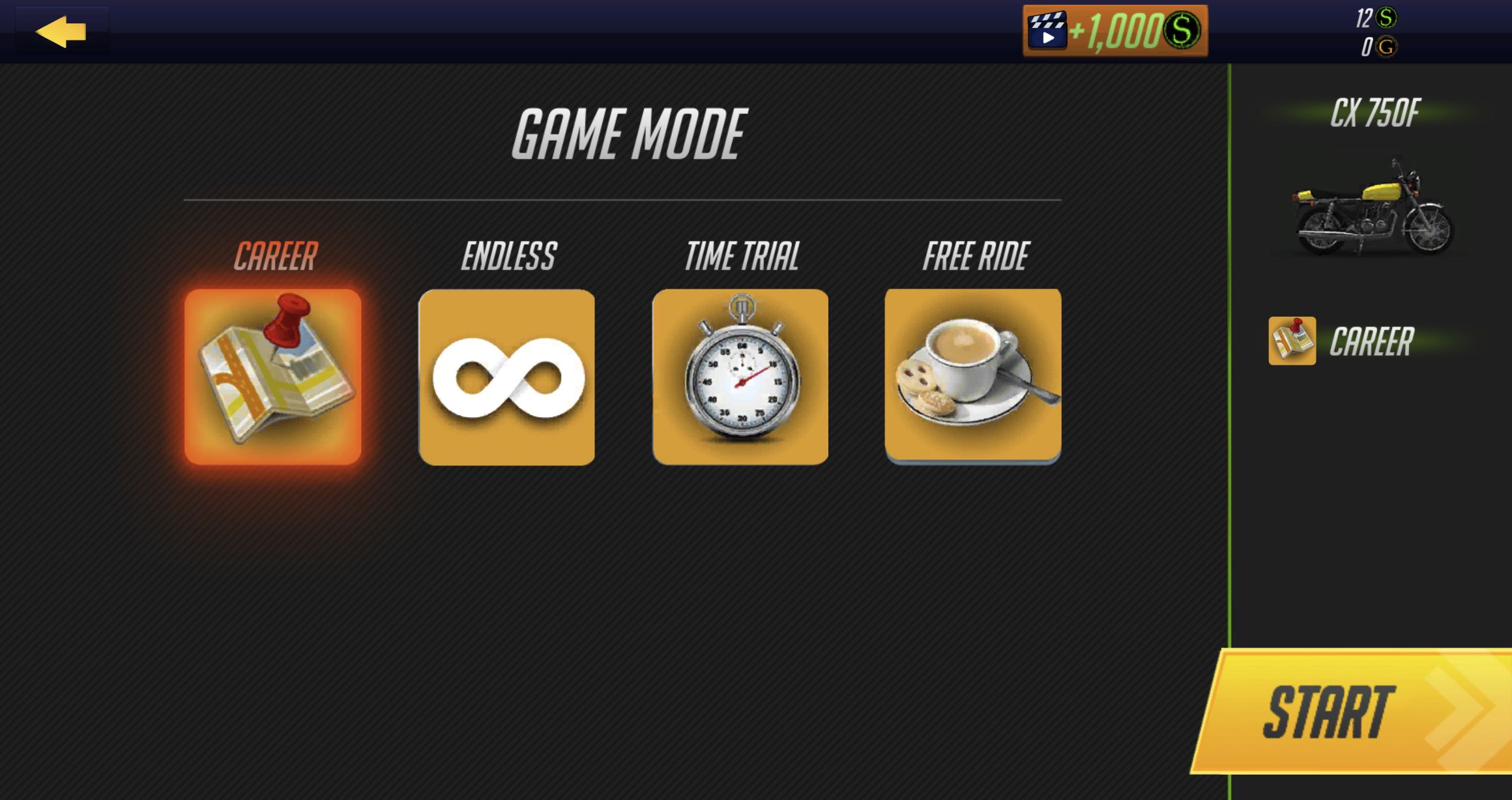
Start opens a clean four-choice mode screen: Career, Endless, Time Trial, and Free Ride. Their icons communicate the split quickly—a pinned map, an infinity symbol, a stopwatch, and a coffee cup—but only Career was tested through complete runs. That distinction matters because an empty road during my first mission does not prove that Endless or Free Ride uses the same pacing, traffic density, timer, or scoring.
The selection screen is one of the game's strongest presentation moments on desktop. Mode names are large, the current CX 750F remains visible in a right-side panel, and the yellow Start control is hard to miss. Inside the portrait mobile modal, the same landscape UI stayed horizontal and shrank dramatically. It still functioned, but the mode labels and lower status icons became small enough to require deliberate attention.
Mission 1 states the bargain clearly: finish, then finish faster
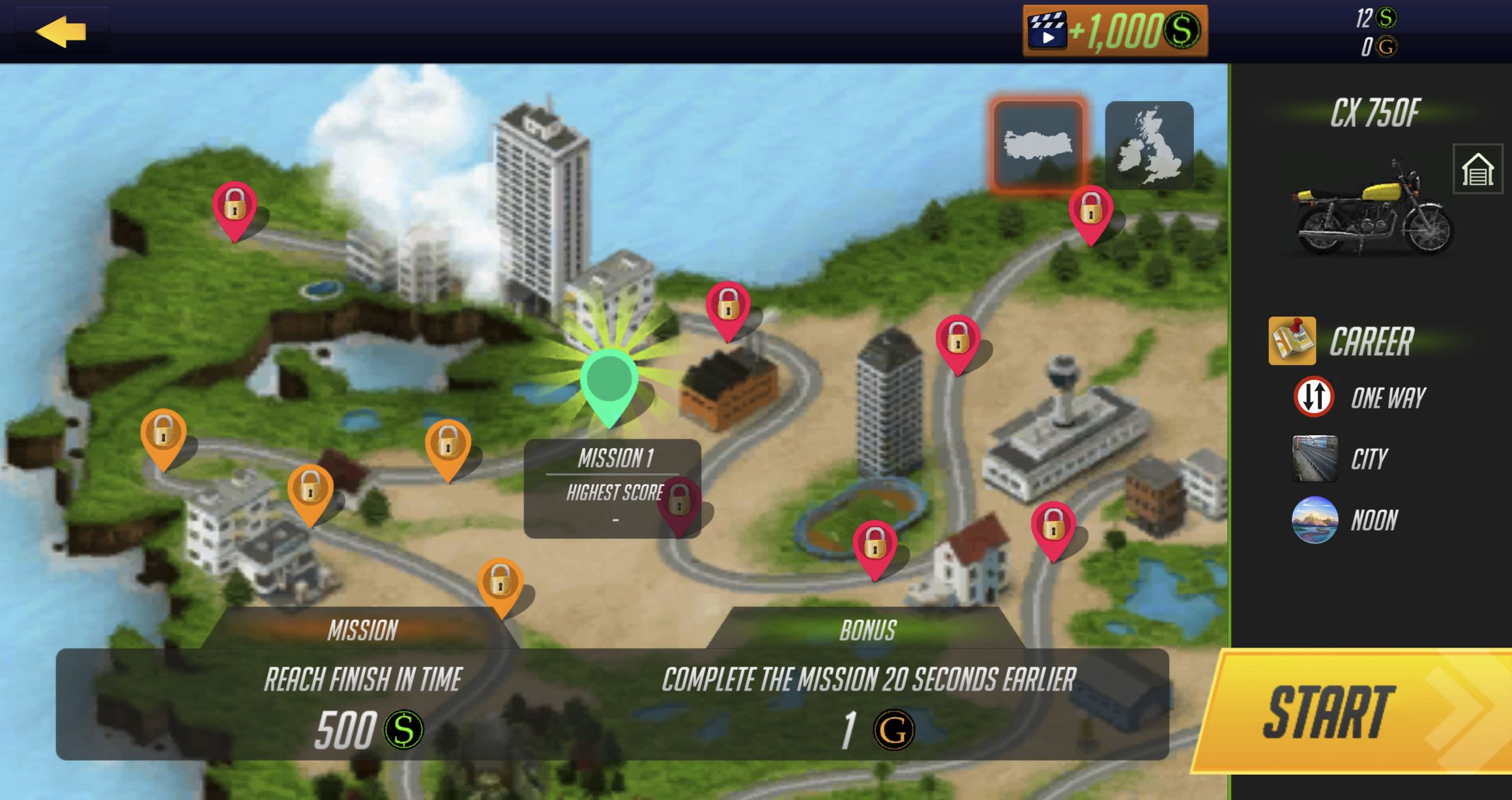
Career begins on an island-style map full of locked pins. Mission 1 is the only highlighted starting point in my session. The side panel identifies the setup as One Way, City, and Noon. Across the bottom, the main condition reads Reach finish in time for 500 $, while the bonus asks for completion 20 seconds earlier and offers 1 G. That is a useful two-layer target: merely survive the clock first, then return with enough pace to chase the bonus.
I did not get far enough to judge later mission variety or any upgrade curve. The map suggests a longer route through multiple locked locations, but a visible locked pin is not evidence of what its event contains. What I can say is that Mission 1 gives better context than the sparse road itself: the timer is the primary opponent, and the displayed premium-looking G bonus rewards a substantially faster finish rather than an unexplained random payout.
Short presses felt gentle; portrait touch made the wide cockpit cramped
On desktop I focused the canvas and used repeated Arrow Up presses, with sampled left and right presses for steering. Each short acceleration input felt gentle rather than explosive; speed settled in the high teens or around 20 KMH during the recorded portions. Left and right produced only modest visual shifts, with no snap-to-lane animation. That control evidence comes from discrete browser-level presses, so it would be unfair to claim that a naturally held physical key behaves identically. It is still fair to report that my tested input method was not enough to clear the opening timer.
The mobile loop revealed a different compromise. Playflaming's fullscreen dialog opened correctly, confirmed by its visible Exit game control and the absence of the underlying recommendation grid. The game did not rotate its landscape menus for the 390x844 portrait viewport. During the race, the road and both gauges filled a tall central crop, while the side mirrors and much of the handlebar width disappeared. I tried one rightward and one leftward horizontal drag. The bike continued at 20 KMH—from 0.02 KM with 37.9 seconds left to 0.13 KM with 32.9 seconds left—but there was no visible touch-control marker or strong lane-feedback cue.

The result screen is blunt, useful, and tied to another ad choice
Failure is reported with useful precision. The direct desktop summary showed Level 1, Score 0, Time Is Up, total distance 0.33, zero close overtakes, zero high-speed score, and a total of 12 $. Mobile ended at 0.37 with the same zero score and a 12 $ total. Those small distance rewards mean a failed attempt is not completely empty, although I did not return to the garage to spend them and cannot verify an upgrade price or effect.
Before the summary, a continue panel offered either Yes for 1 G or a separate ad-marked free continuation. I chose No, preserving the honest result instead of extending it. Motorcycle Racer: Road Mayhem will suit players who enjoy cockpit views, explicit mission targets, and retry-based progression, and who do not mind advertisements interrupting the route to another run. Of the two tested layouts, desktop is the clearer recommendation: it keeps the full horizontal scene, mode names, map goals, and HUD legible. The portrait modal did complete a real loop, but its compressed menus and narrowed cockpit make it a compromised way to learn the game.
