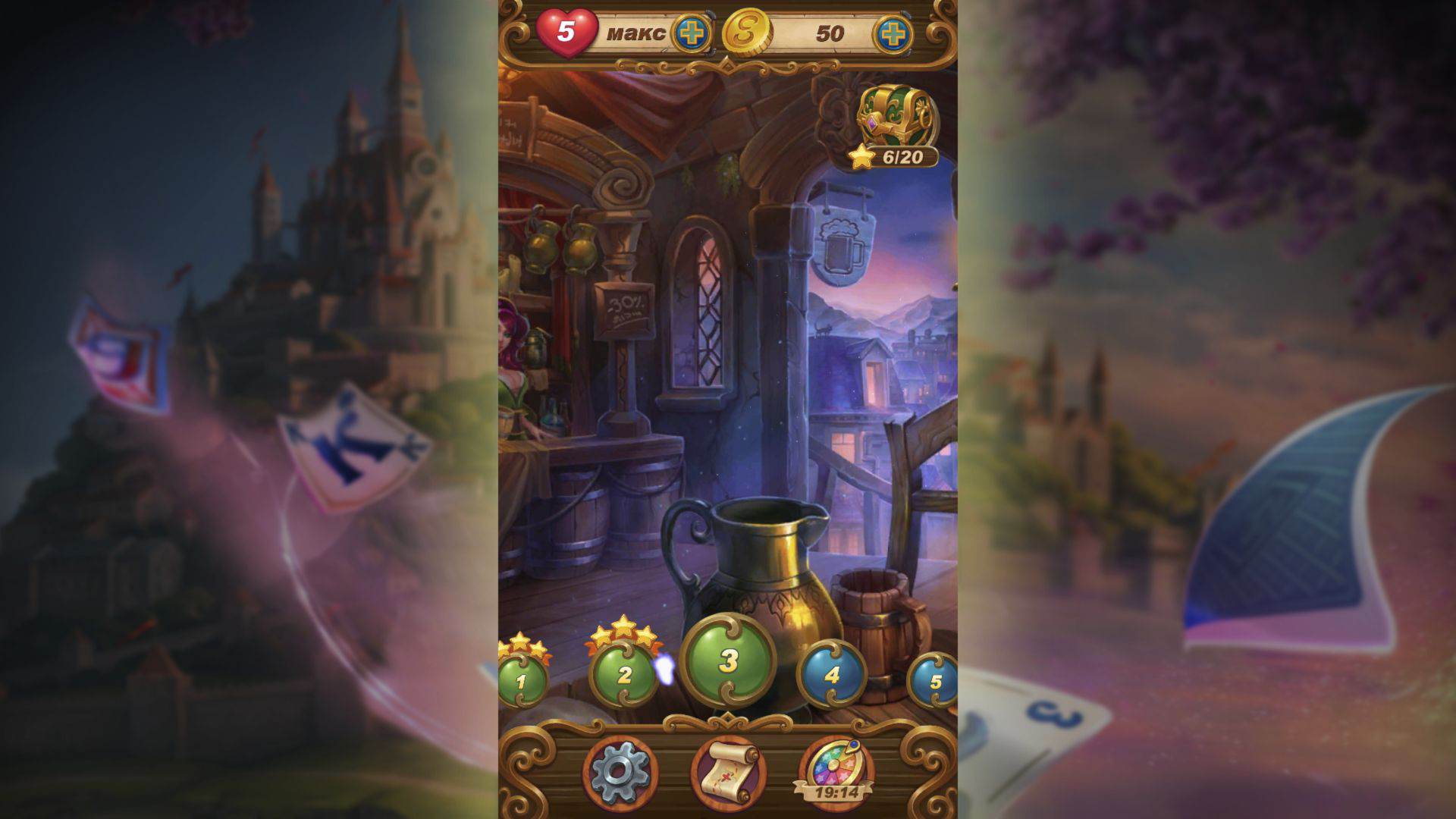
Two Cleared Boards Left the Star Chest at 6 of 20
My desktop session covered the guided opening board and the next full board. I cleared both, earned three stars on each, left the star chest at 6 of 20, and unlocked level 3. The result was unusually clean because the second layout could be read as two long runs: I started from the ace, climbed through the low cards, later wrapped from ace to king, and finished with four cards still visible before the final sequence disappeared into the waste pile.
That does not make Magic Story of Solitaire automatic. Every exposed card changes what sits underneath it, and a tempting legal move can close a longer route on the opposite side. The stock is a limited escape hatch rather than the main action. I completed the tested boards without randomly burning through it, which is exactly where the game felt more thoughtful than its ornate fairy-tale presentation initially suggested.
The Fairy Taught a Simple Rule in an Unexpected Language
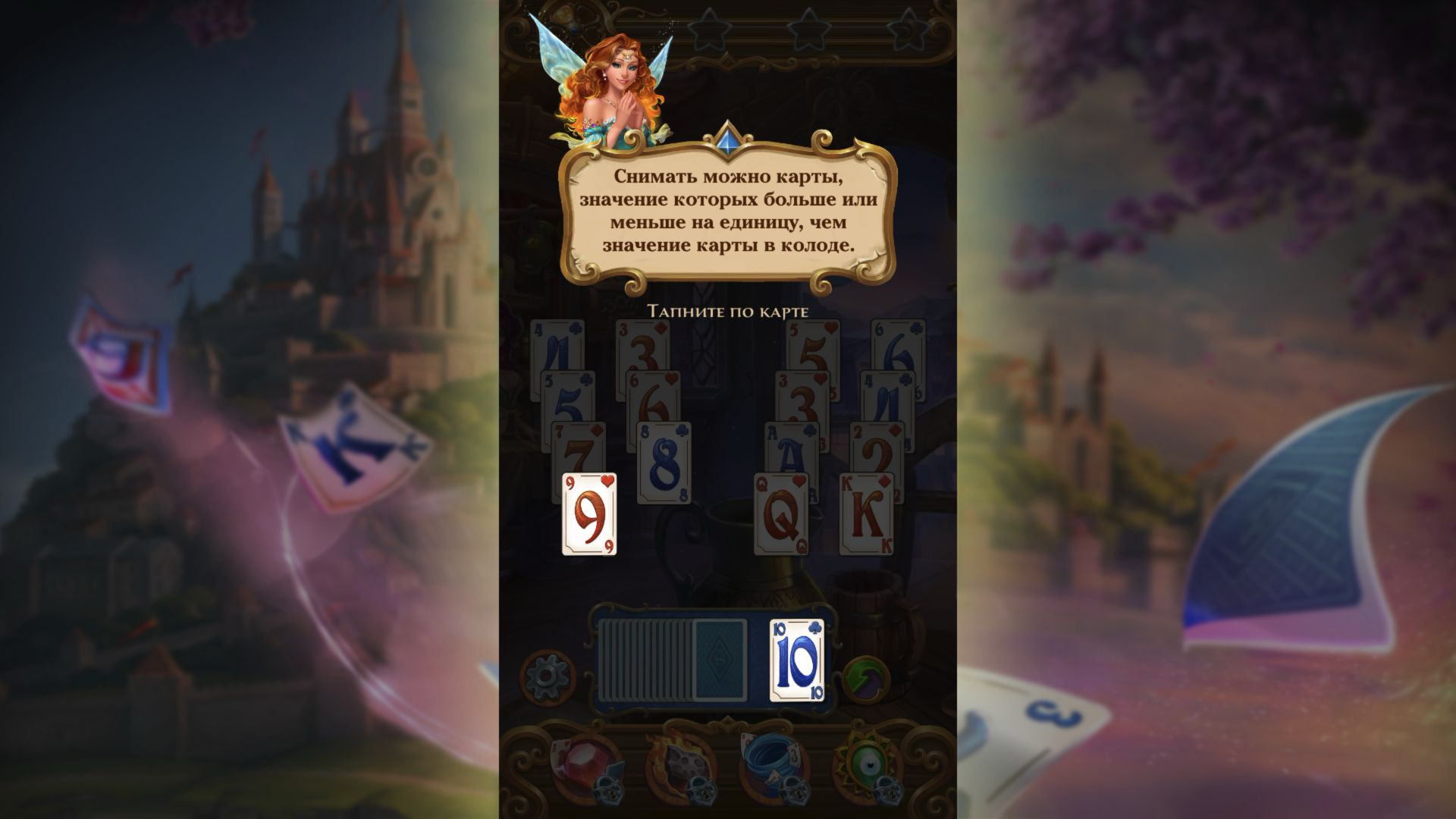
The first screen asked whether I already knew how to play solitaire and offered a tutorial or a skip button. The catalog declares English (United States), but this session's interface rendered in Russian. That was the sharpest onboarding problem I encountered. The fantasy art is attractive and the card values are universal, yet a player relying on English text should not have to translate the fairy's explanations to understand combo timing or progression screens.
I chose the tutorial and followed the visible highlights. The core rule is easy: remove an exposed card when its rank is exactly one higher or one lower than the current waste card. Suits do not matter. A jack accepted either a ten or queen; after choosing ten, the board revealed a nine, then an eight, seven, six, five, four, and three. Each click responded quickly in the direct desktop player, while illegal cards simply stayed put.

K-A Wraparound Turned the Ace into a Real Route Choice
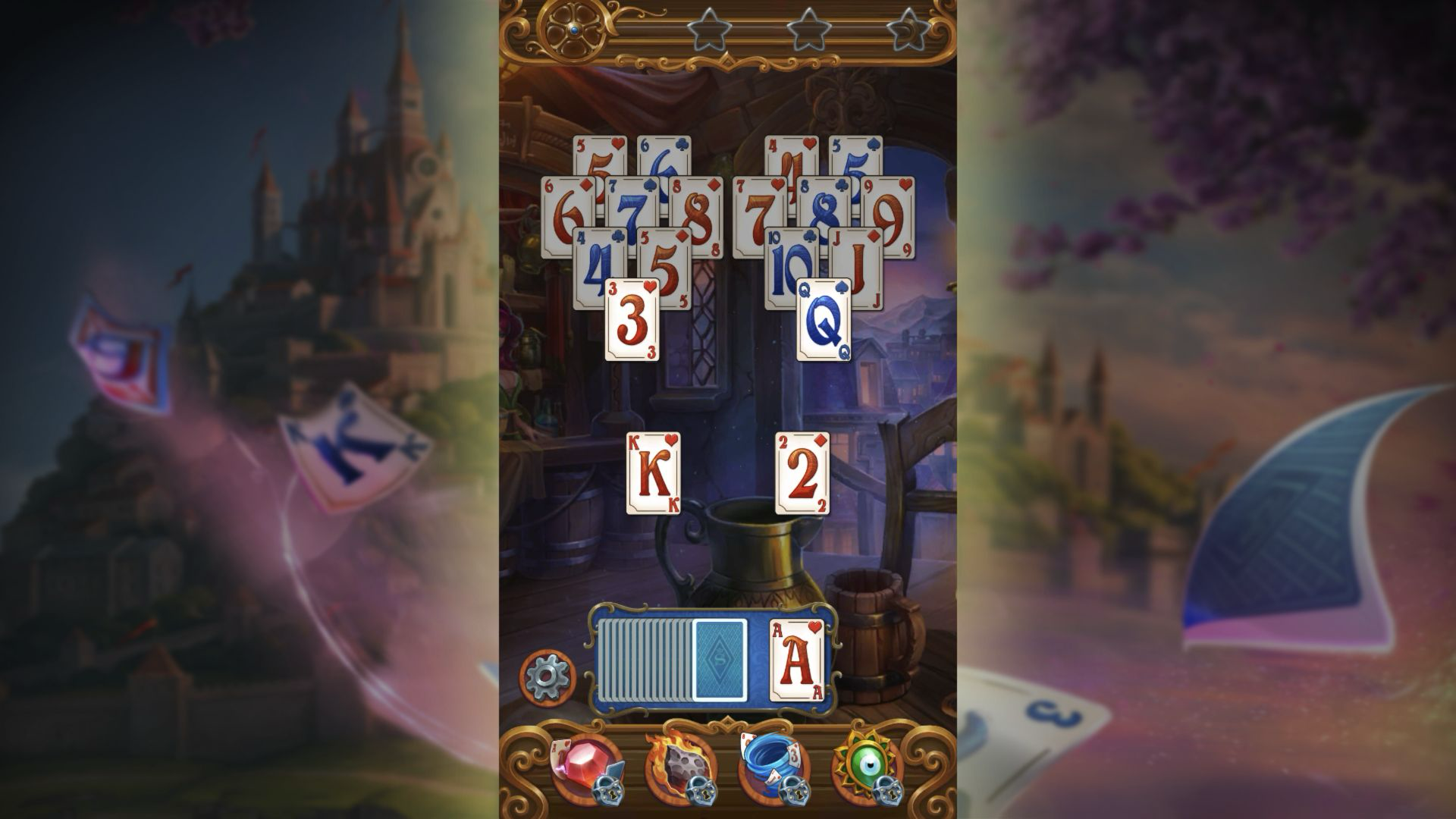
The most useful rule the opening board proved was that ace connects to both two and king. Late in the tutorial I played queen to king, king to ace, and ace to two without drawing a replacement. The second board then began on an ace with a king on the left and a two on the right, turning that rule into an immediate strategic fork rather than a trivia detail.
I chose the two because its branch exposed a readable climb through three, four, five, six, seven, and eight. New players should scan beyond the first legal move and count at least two cards into each branch. When an ace appears, check both ends of the rank ladder. A king may be the start of a queen-jack-ten descent, while a two may open a long low-card climb. The strongest move is the one that uncovers the next legal rank, not necessarily the closest card to the waste pile.
Five Consecutive Cards Activated Combo Scoring
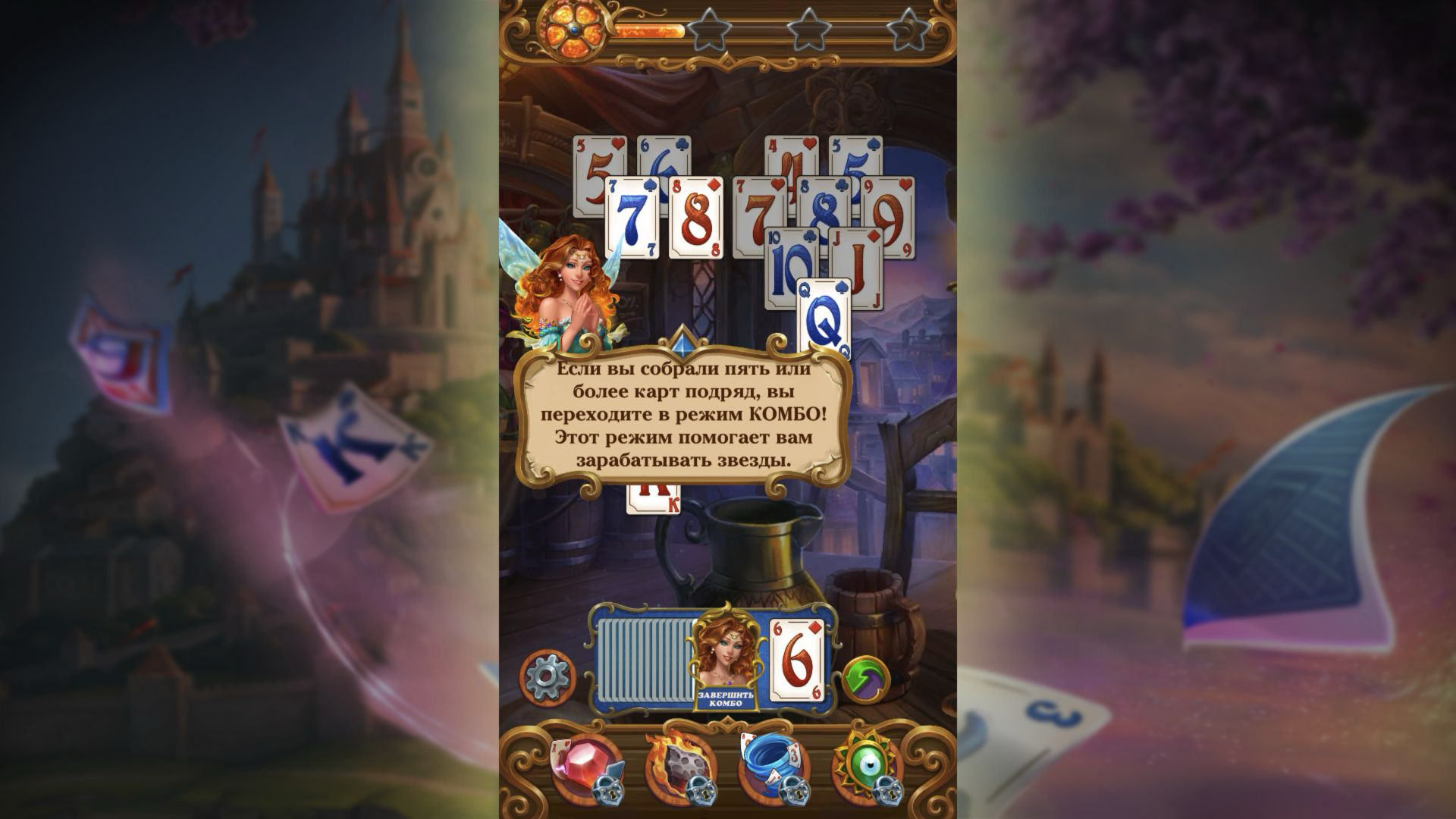
After my fifth consecutive removal, the game paused to explain combo mode. A circular meter at the top filled as the chain continued, then illuminated the three star markers. This scoring layer gives the one-rank rule a second purpose: long routes do not only preserve stock cards, they also improve the level result. By the end of each tested board, all three stars were lit.
Combo mode also introduces a slightly awkward control. A fairy portrait labeled as ending the combo can cover part of the waste area. When the current run stopped, clicking that portrait banked the streak and exposed a fresh stock card. The first time this happened, I tried selecting more board cards before realizing the portrait was the required transition. Once understood, it was reliable, but a clearer icon would reduce that moment of friction.
The Last Four Cards Rewarded Route Planning, Not Luck
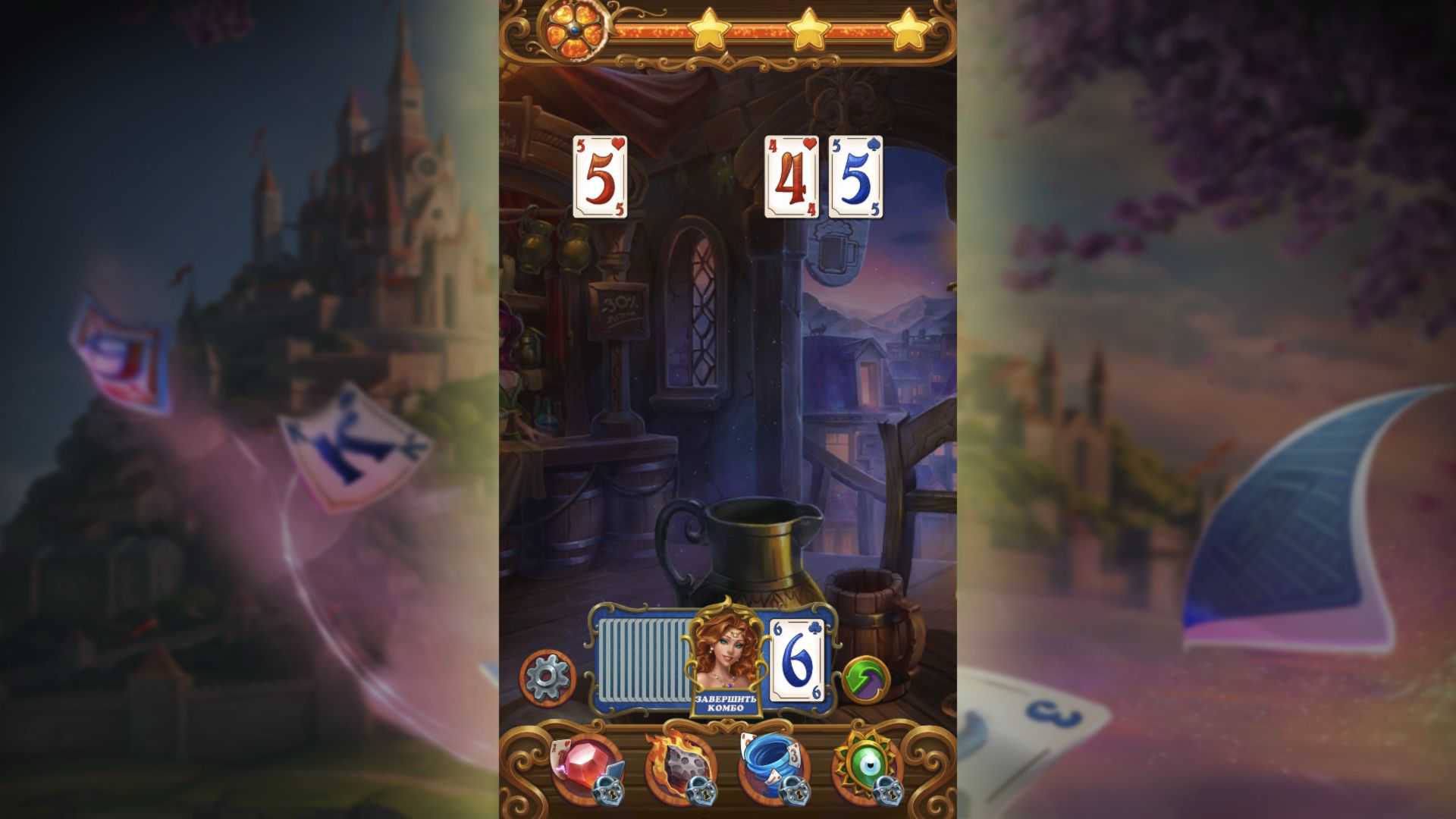
The clearest proof came at the end of the second board. Only four cards remained: a five on the left, then a four and another five on the right, with six already in the waste pile. The route was therefore six-five-four-five. Because I had preserved that order while clearing the upper layers, the finish required no stock draw and no booster.
That is the beginner habit I would carry into later levels: pause whenever several exposed cards are legal, then ask which choice reveals a continuation. Drawing immediately may rescue the current turn, but it also spends one of the face-down cards shown beside the waste pile. The opening inventory displayed four locked power-up icons, so the early game is clearly designed to be solved with rank reading before special tools take over.
The Clear Animation Made the Three-Star Finish Feel Earned
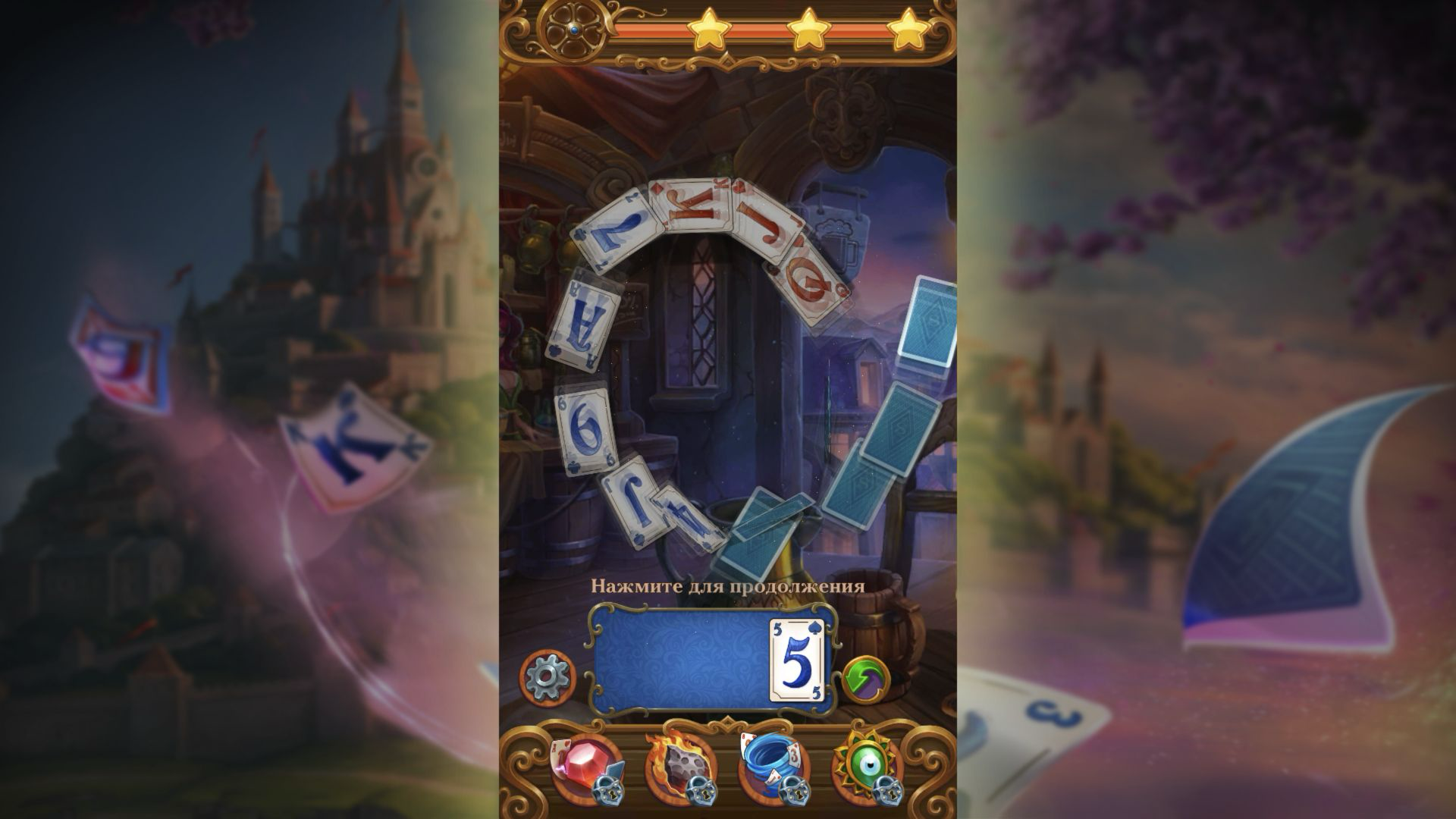
Removing the final card triggered a ring of cards around the empty tableau and a prompt to continue. There was no numeric score on that screen, so I did not invent one. The concrete result was three lit stars, followed by the chapter map showing levels 1 and 2 complete, level 3 available, five lives, 50 coins, and 6 of 20 stars toward the chest.
The surrounding progression is light but effective. A storybook map, chest target, lives, coins, locked boosters, and richly painted backgrounds make each board feel like a step through a campaign rather than an isolated deal. During the two completed desktop loops, I encountered no purchase prompt or forced login. The provider record also labels in-game purchases as unavailable, although plus buttons beside lives and coins suggest those counters will matter later.
Beautiful on Desktop, but the Mobile Loop Could Not Be Verified
The verified desktop build ran in a 1920 by 1080 browser viewport. Its actual playfield is portrait-oriented, with blurred fantasy artwork filling the side space. Cards, waste pile, stock, combo meter, and boosters stayed readable, and mouse input was precise once I used the direct Playgama export after the local inline iframe failed to accept canvas clicks. The Bridge Playgama splash added a short startup wait, but neither completed board was interrupted after play began.
Android and iOS are declared in both catalog records, so I also opened the local Playflaming route at 390 by 844 and tapped Play. The required fullscreen modal appeared with its back control and player boundary, but the cross-origin canvas did not accept the available emulated touch input after browser-level and native-input recovery attempts. I therefore did not substitute the direct export as mobile evidence, did not publish mobile gameplay screenshots, and cannot recommend one device over another.
On the environment I could finish, Magic Story of Solitaire suits players who enjoy Golf-style solitaire, lavish fantasy art, forgiving early layouts, and score-chasing through long visible chains. The two real drawbacks were the unexpected Russian localization and the blocked mobile interaction path. On desktop, start by tracing both sides of every ace, preserve the stock until no route remains, and prioritize five-card chains whenever the tableau makes them visible.