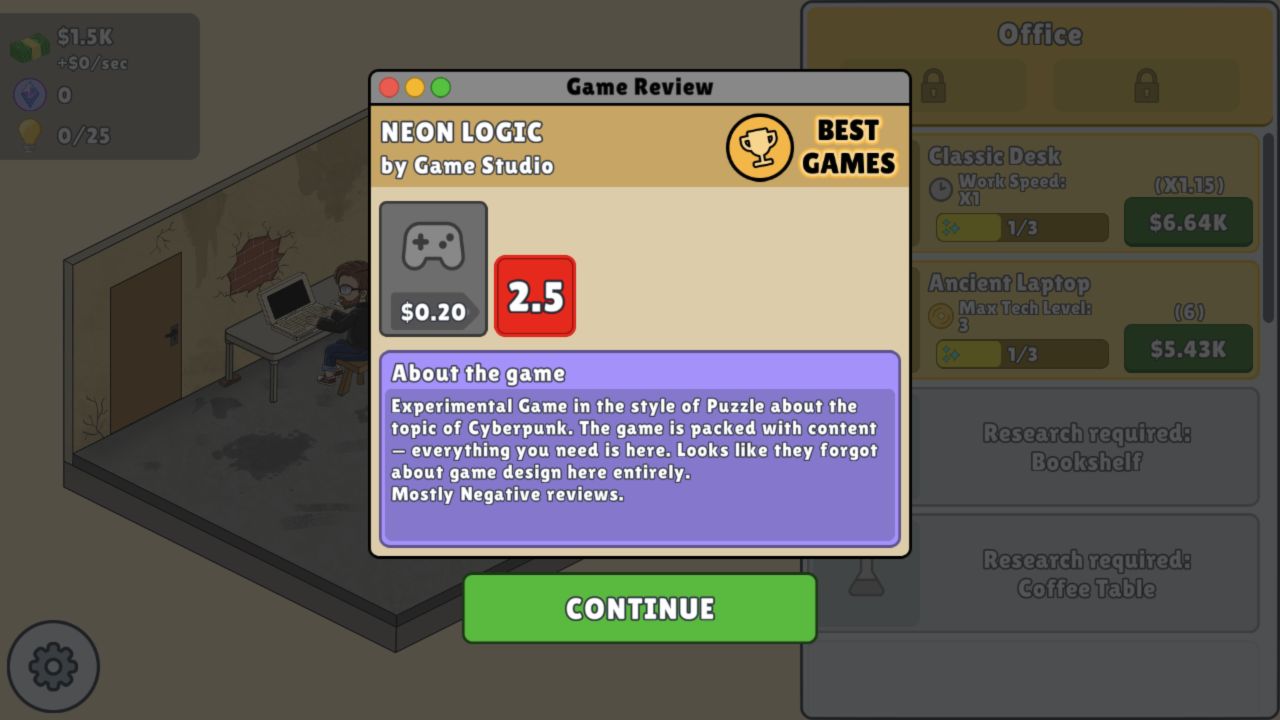
NeonLogic Shipped at 2.5, and the Review Blamed Game Design
My first full cycle in Idle Game Dev Simulator produced NeonLogic, a D-size Puzzle game with a Cyberpunk topic for PC. I left the default price at $0.20, developed it with the garage's starter equipment, and published with zero bugs. The verdict was still rough: 2.5 and Mostly Negative. The review called the game packed with content and then said its design had effectively been forgotten.
That result was more useful than an easy tutorial success. It separated technical completion from product quality: a clean bug counter did not compensate for weak design, and a full set of content did not guarantee players would like the combination as executed. Idle Game Dev Simulator is at its best when it lets a poor release become actionable data instead of treating every completed progress bar as a victory.
The Garage Starts with $1.5K but Makes the First Furniture Free
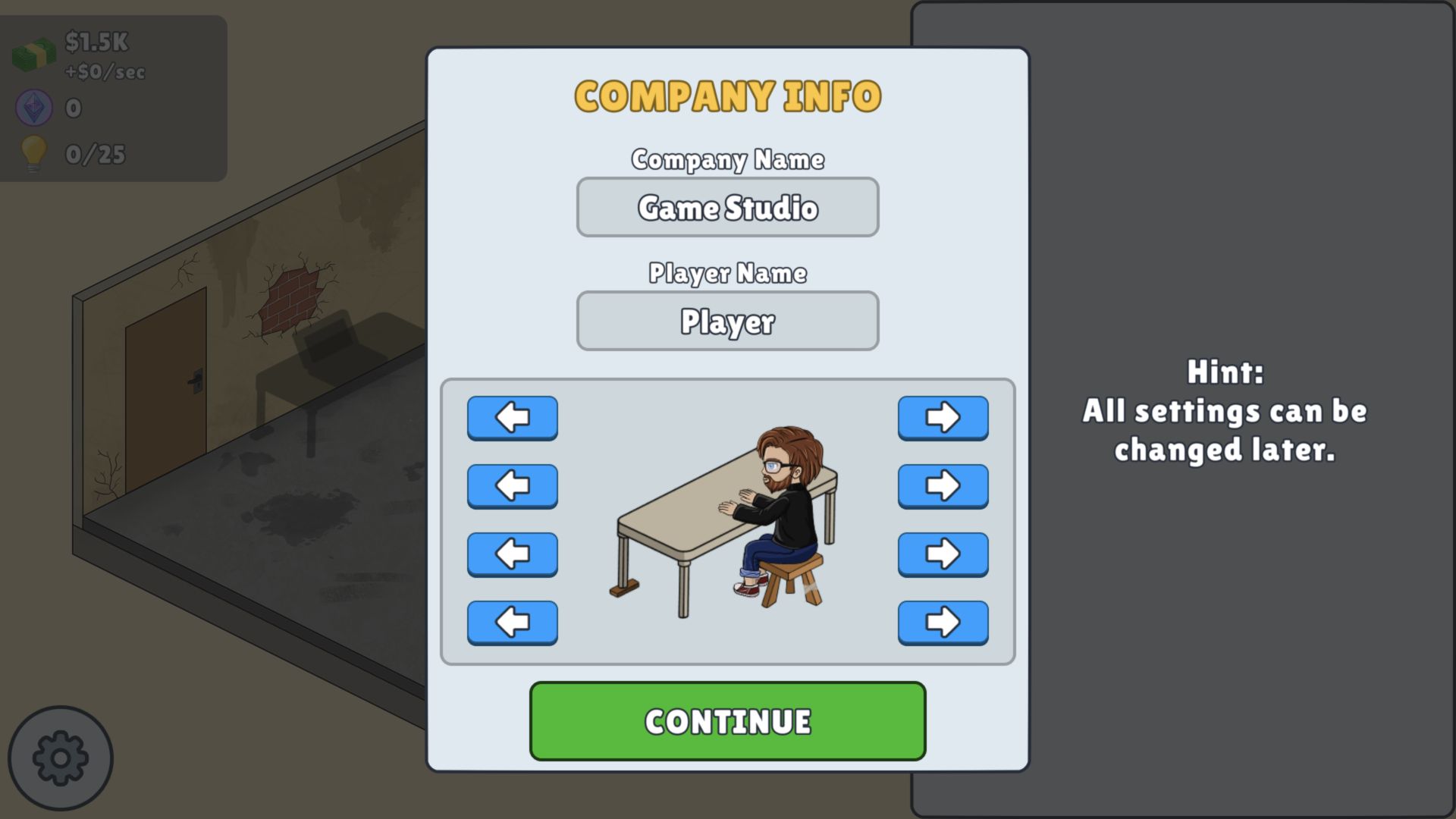
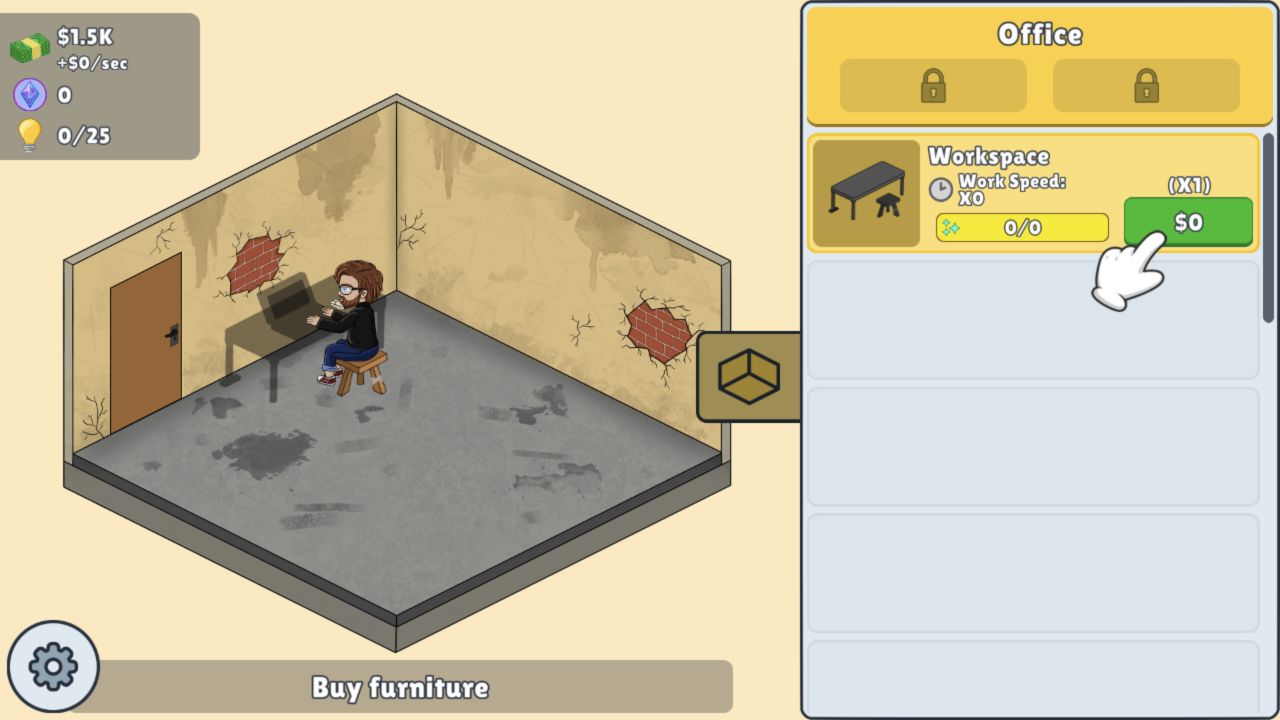
The session began in a stained, cracked garage with $1.5K cash, zero gems, zero of 25 ideas, and no passive income. Company Info offered the default names Game Studio and Player plus several appearance arrows. I kept every default. The tutorial then asked for a workspace and laptop, but both first purchases cost $0, so there was no early trap hidden behind the setup instructions.
Buying the Workspace installed a Classic Desk at work speed x1. The next desk tier immediately jumped to $6.64K and advertised a x1.15 speed multiplier. The free Workstation became an Ancient Laptop with max tech level 3; its next upgrade was $5.43K. Those prices made the opening economy clear before a game existed: the free setup enables production, while meaningful equipment improvement requires several successful releases or a long period of income.
Puzzle, Cyberpunk and PC Began as Three Unknown Relationships
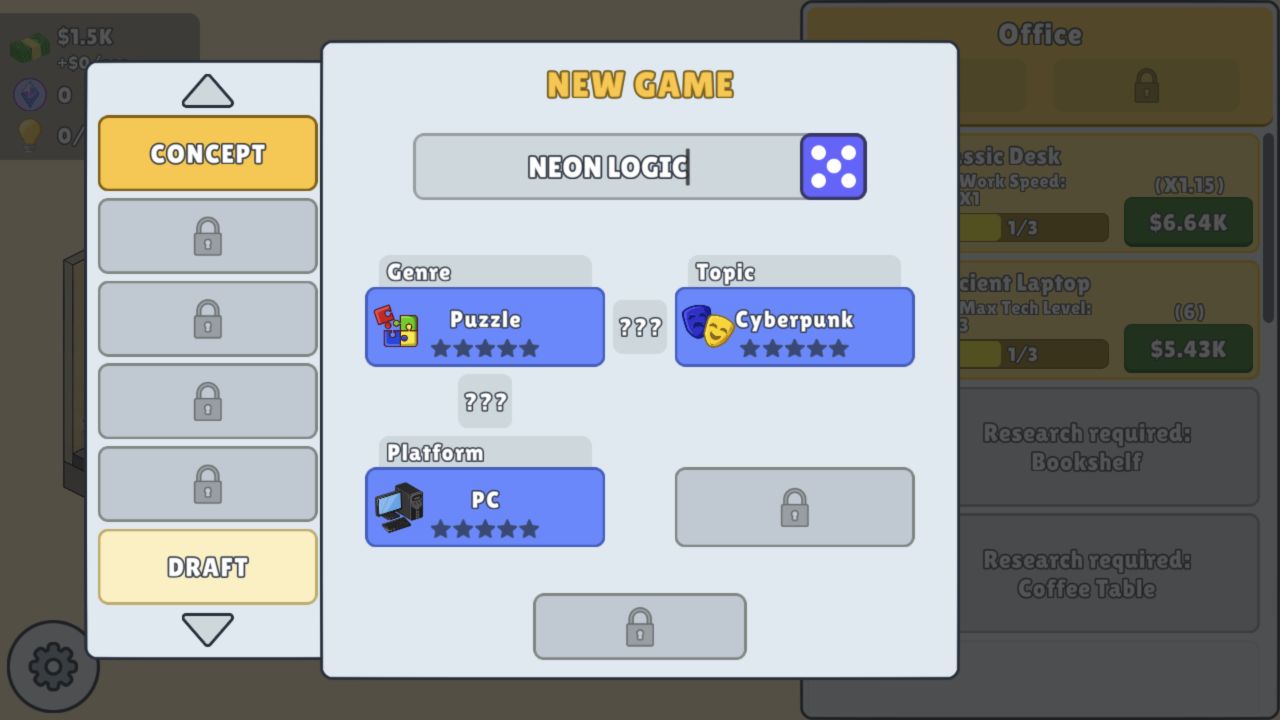
The first concept menu did not offer unlimited creativity. Only Action and Puzzle were unlocked as genres. The visible starting topics were Contract Killer, Cyberpunk, and Dragons, while PC was the only available platform. I chose Puzzle and Cyberpunk because it sounded more distinctive than a predictable action pairing, then named the project NeonLogic. Question marks appeared between genre, topic, and platform, so I knowingly committed without compatibility data.
This discovery structure gives the simple menu a real decision. Stars beneath each option were initially empty, and many later slots were locked. A beginner cannot optimize from a spreadsheet on the first attempt; the game expects experimentation, publication, and analysis. That suits the fantasy of learning an audience, although it also means a weak first rating can come from hidden relationships rather than a clearly avoidable mistake.
The D-Size Draft Cost Nothing and Set the Price at Twenty Cents
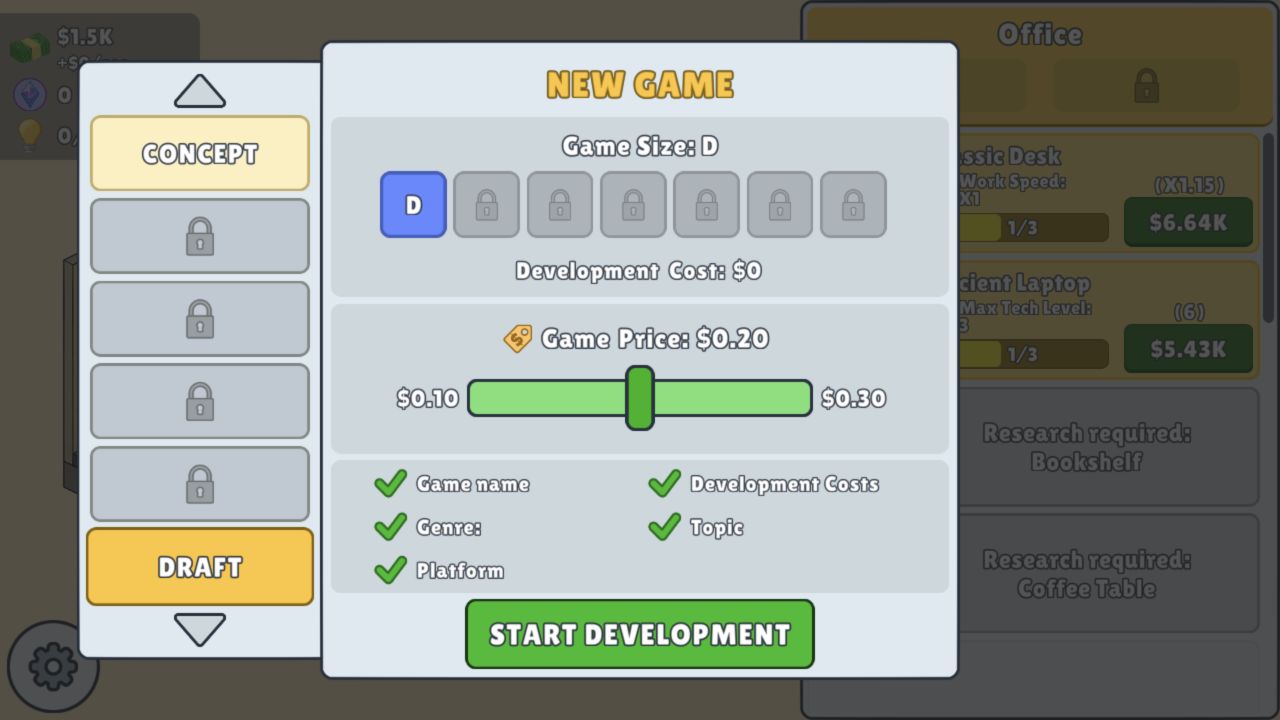
The Draft page confirmed game size D, Development Cost $0, and a price slider ranging from $0.10 to $0.30. I left it centered at $0.20. Green checks verified the game name, genre, topic, platform, and development costs before the Start Development button became the obvious next step. Larger sizes and later production stages were visibly locked, so the opening project stays focused.
I liked seeing price before production rather than after reviews arrive. Even though the first cost was waived, the twenty-cent choice directly shaped revenue: each thousand sales would be worth about $200. The weakness is that the tutorial gives no market-demand forecast at this point. With platform compatibility still unknown, the slider feels more like a declared experiment than an informed commercial decision.
Twenty Development Points Produced Zero Bugs but Uneven Skills
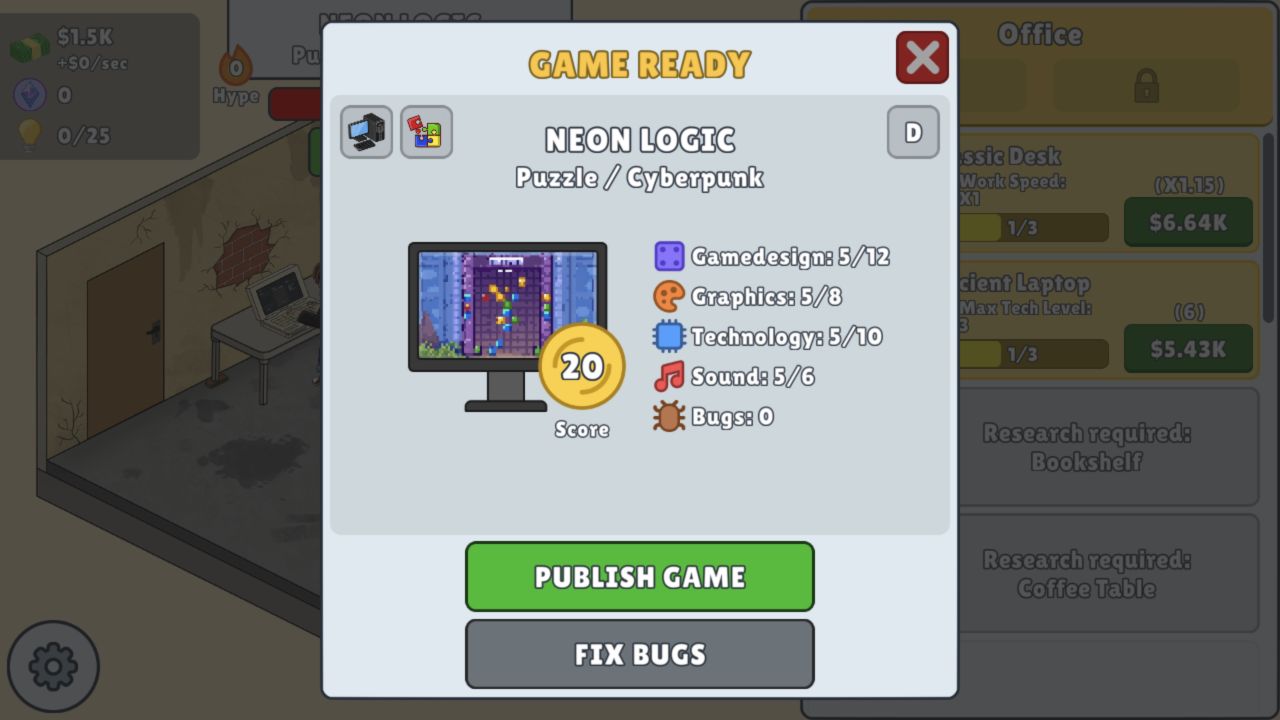
Development itself was automatic. The character worked at the Ancient Laptop while colored design, graphics, technology, and sound symbols floated across the garage. After a short wait, the top progress bar reached 20 and Results unlocked. The Game Ready panel broke that total into Game Design 5/12, Graphics 5/8, Technology 5/10, and Sound 5/6, with Bugs 0.
Those ratios explain the review better than the headline score alone. Sound nearly filled its available capacity, while design reached less than half of its possible twelve points. Because Fix Bugs was disabled at zero, there was no useful cleanup pass to perform; Publish Game was the only meaningful choice. Future runs should improve the desk, research better production options, or choose a concept that benefits more from the starter skill profile instead of assuming a bug-free build is ready to impress.
A Bad Review Still Sold 8.95K Copies and Raised Income to $9 per Second
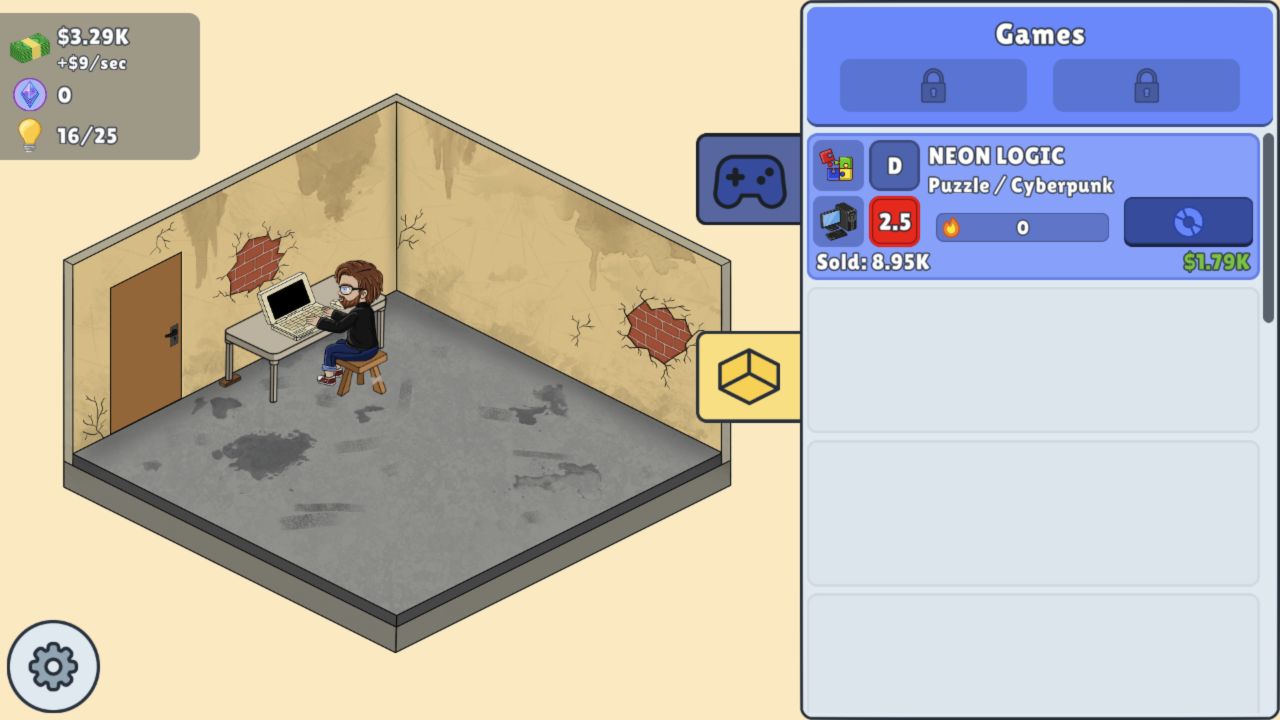
Publishing turned the static project into an income stream. The first visible sales card showed 99 copies and $19.80, exactly matching the chosen twenty-cent price. As the tutorial conversation continued, the numbers rose in real time. Before analysis, the card showed 4.21K sold and $842.60 earned; after the analysis rewards were collected, it reached 8.95K sold and $1.79K.
The studio balance ended at $3.29K with +$9/sec, up from the original $1.5K and +$0/sec. That still was not enough for either $5.43K laptop or $6.64K desk upgrade, so the game creates a useful wait-or-build tension after one cycle. No video reward, ad multiplier, double-income prompt, rewarded continuation, shop, cash purchase, or login appeared during this process. The visible money, gems, ideas, sales, and price were all internal simulation resources or results.
Analysis Turned the Failure into Sixteen Ideas
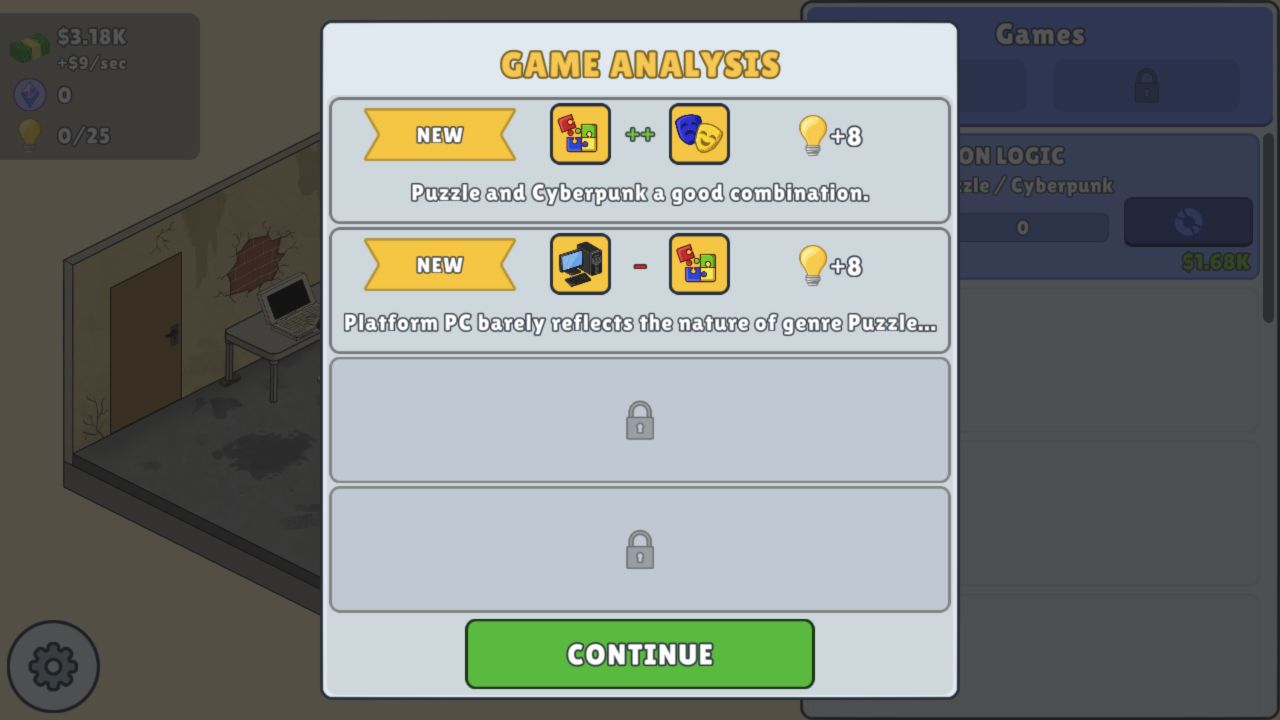
The tutorial's best decision arrived after release. An analysis of NeonLogic took about twelve seconds, then presented two hidden cards. Revealing the first said Puzzle and Cyberpunk were a good combination and awarded +8 ideas. Revealing the second warned that PC barely reflected the nature of Puzzle and awarded another +8. The ideas counter moved from 0/25 to 16/25.
This changes the 2.5 rating from arbitrary punishment into reusable knowledge. My unusual theme choice was not the core error; the only unlocked platform was the weak fit. Players who enjoy management games built on iterative discovery will find a solid hook here: release, earn, analyze, then make the next brief with better information. The main friction is that the first platform mismatch is unavoidable when PC is the sole option, so patience matters more than flawless planning at the beginning.
This Verdict Covers Desktop Chrome, Not the Declared Mobile Versions
The catalog declares desktop, Android, and iOS support, but only the desktop loop could be completed. When I switched to the required 390-by-844 local Playflaming route, Chrome's security policy blocked the page before Play could load. I did not replace that route with a narrowed desktop canvas or treat the direct game export as mobile evidence, so touch layout, fullscreen-modal controls, orientation behavior, and real-phone performance remain unverified.
I therefore cannot recommend one device over another. On desktop, the isometric garage and right-side management panels were easy to read, and the entire create-develop-review-sell-analyze loop worked without authentication. Idle Game Dev Simulator will suit players who like watching modest numbers become feedback for the next project more than players seeking hands-on coding or deep production staffing. Its first hour is deliberately guided, but NeonLogic's poor review proved that the choices still have consequences.