My First Useful Move Was About Making Space
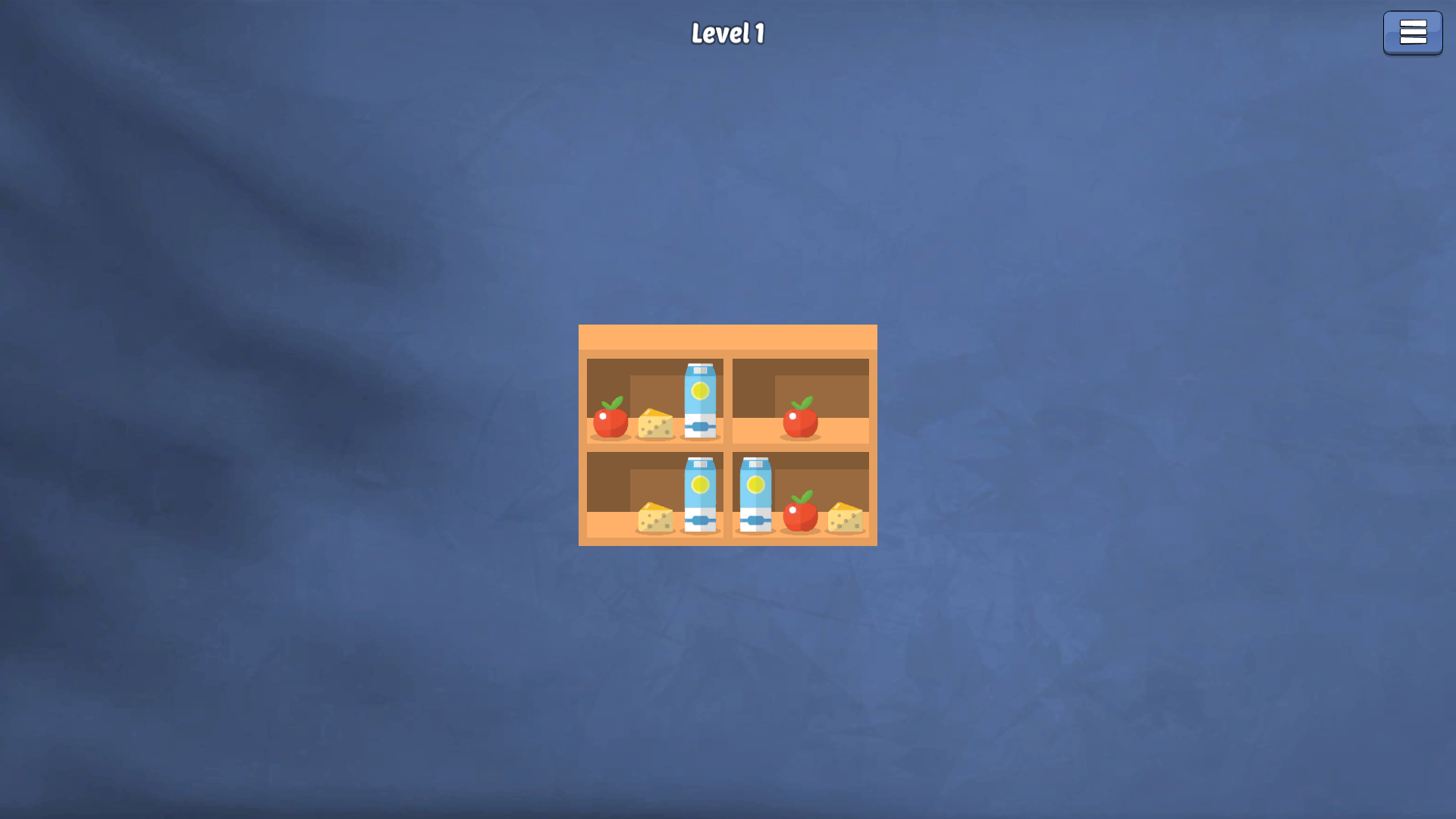
Level 1 began with nine objects split across four shelf compartments: three apples, three cheese wedges, and three milk cartons. The rule is simple enough to understand from the board itself. Drag an object into another compartment, place three identical objects together, and the set disappears. What made the opening more interesting was that no compartment already held an obvious triple. I first moved the lower-right apple beside the apple in the upper-right compartment, turning a single object into a pair and freeing room below.
The next drag carried the upper-left apple into that pair. All three apples vanished immediately, leaving three empty places rather than awarding points on a separate counter. That first clear taught the real lesson: matching is useful because it creates working space. The puzzle is less about spotting three identical pictures than deciding which temporary pair will leave the cleanest board for the items still waiting.
The local Playflaming embed reached the game without a login. Its first launch paused at a short-break preparation screen before Level 1 appeared. I did not click the advertisement area. Once I moved to the direct game export for a clean test viewport, the completed level and transition into Level 2 were not interrupted by another ad in the observed sequence.

A Triple Clears Instantly, but the Board Keeps Reordering
Objects re-center inside a compartment after every accepted move. That animation looks tidy, but it also means the exact screen position of an item can change even though it stayed on the same shelf. I had to keep reading the compartment rather than memorizing a coordinate. On Level 1 this is gentle because the icons are large and the three item types have very different silhouettes. The apple is round and red, the cheese is low and yellow, and the milk carton is tall and blue.
There was no visible timer, move limit, score, or penalty counter in either tested Level 1 loop. I could pause between drags and plan without pressure. That makes the opening approachable, but it also removes some tension for players who expect a strict move budget. The game rewards a clean solution at the end rather than making every inefficient shuffle feel like a failure.

The Milk Route Showed Why Empty Compartments Matter
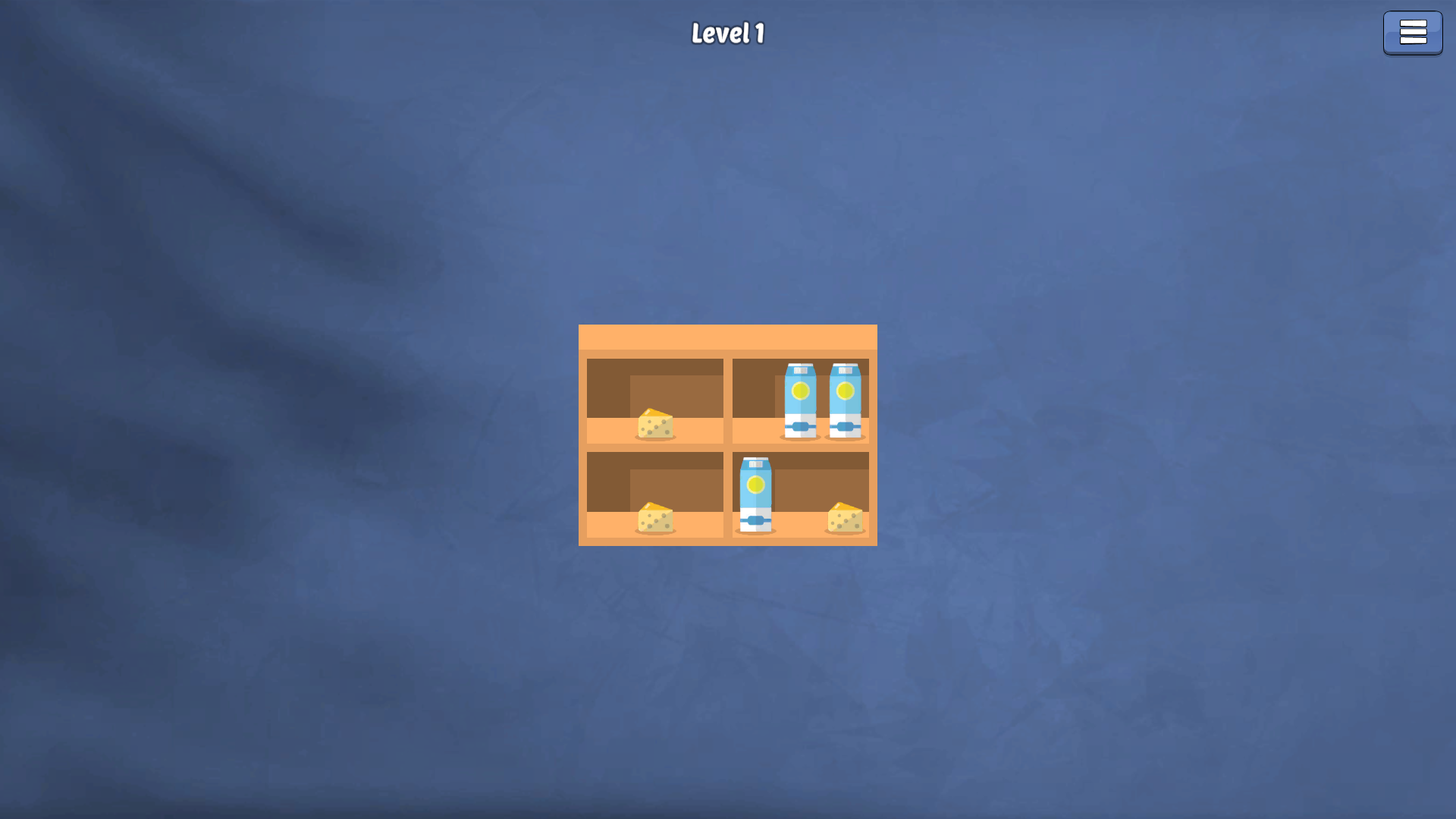
After the apples disappeared, I used the empty upper-right compartment as a staging area for milk. One carton came from the upper-left shelf, a second came from the lower-left shelf, and the final carton came from the lower-right. The first two drags did not score anything; they simply built the pair shown here. The third completed the set and cleared all three cartons at once.
This sequence is a useful beginner pattern. Do not scatter partial pairs across every shelf. Choose one compartment as the destination, move two matching objects there, then look for the safest route for the third. If a destination already contains an unrelated object, clear or relocate that obstruction before committing. Level 1 gives enough spare room to recover, but Level 2 makes poor staging harder to ignore.
Seven Drags Produced a Three-Star Finish
With the milk gone, only three cheese wedges remained. I moved the lower-left wedge into the upper-left compartment, then brought the lower-right wedge across to complete the final triple. The whole solution took seven successful drags: two for apples, three for milk, and two for cheese. Confetti filled the screen, the result panel displayed "Well done!", and three gold stars appeared above a Continue button.
The result screen did not show elapsed time, a move total, coins, or a numerical score, so the three-star rating is the only verified performance result. I repeated the same seven-drag route with emulated touch input at a 390 by 844 CSS-pixel viewport and received the same three stars. That comparable loop confirmed that the touch layout and drag targets work; it does not establish physical-phone frame rate, heat, battery use, or browser stability.

Finishing the Tutorial Unlocks New Shelf Items
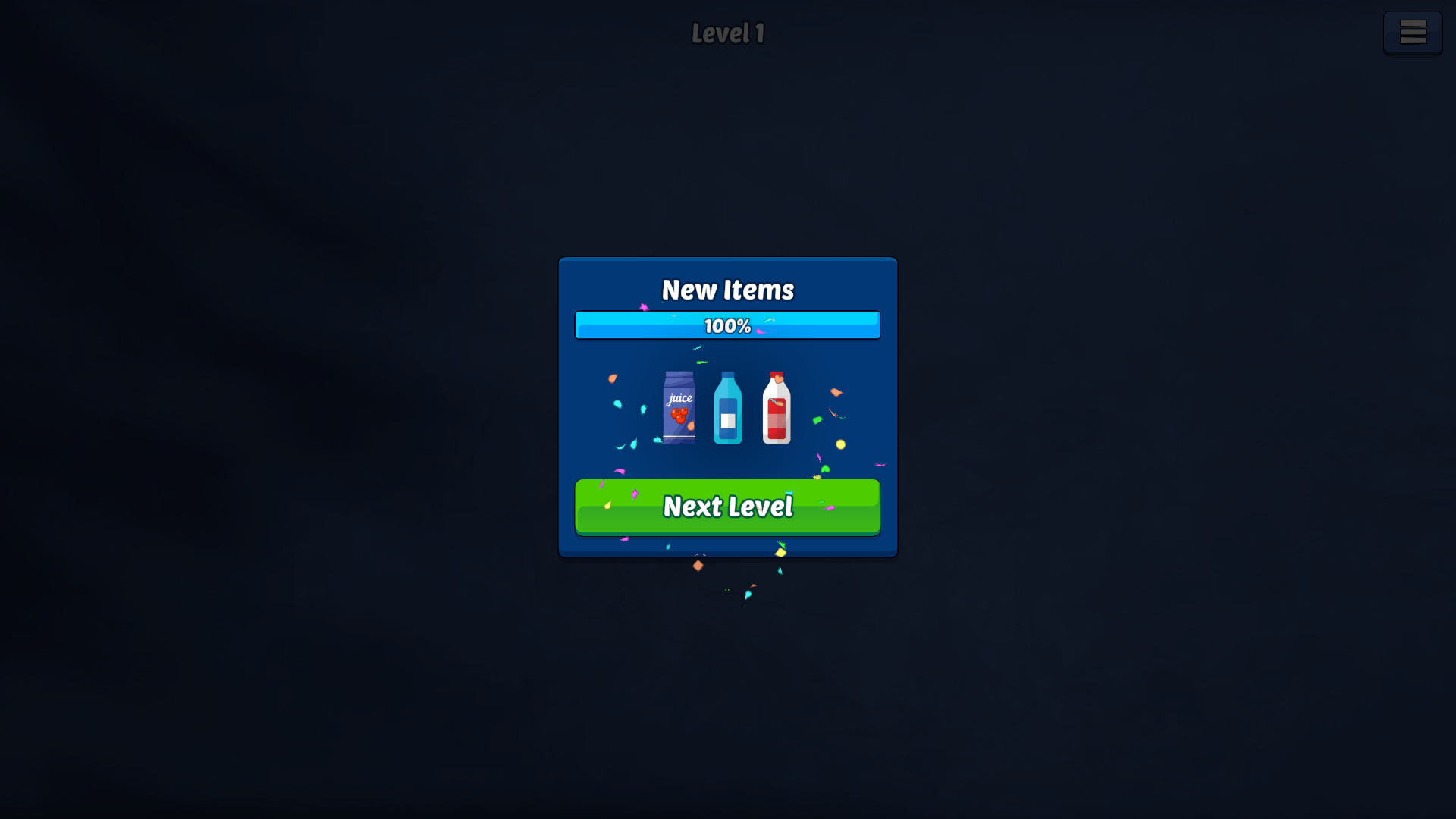
Continue did not jump straight to the next board. It opened a New Items panel with a progress bar at 100 percent and three newly displayed products: a purple juice carton, a blue bottle, and a white bottle with a red label. A separate Next Level button then advanced the session. This small reveal gives the clear a sense of collection progress even though Level 1 itself did not award visible currency.
The screen also explains how the game can increase difficulty without changing its basic control scheme. More item silhouettes mean more visual sorting, and similar bottle shapes are harder to distinguish at a glance than apples, cheese, and milk. I did not encounter a purchase prompt during the completed direct-export sequence.
Level 2 Turns a Four-Compartment Lesson into a Six-Compartment Puzzle
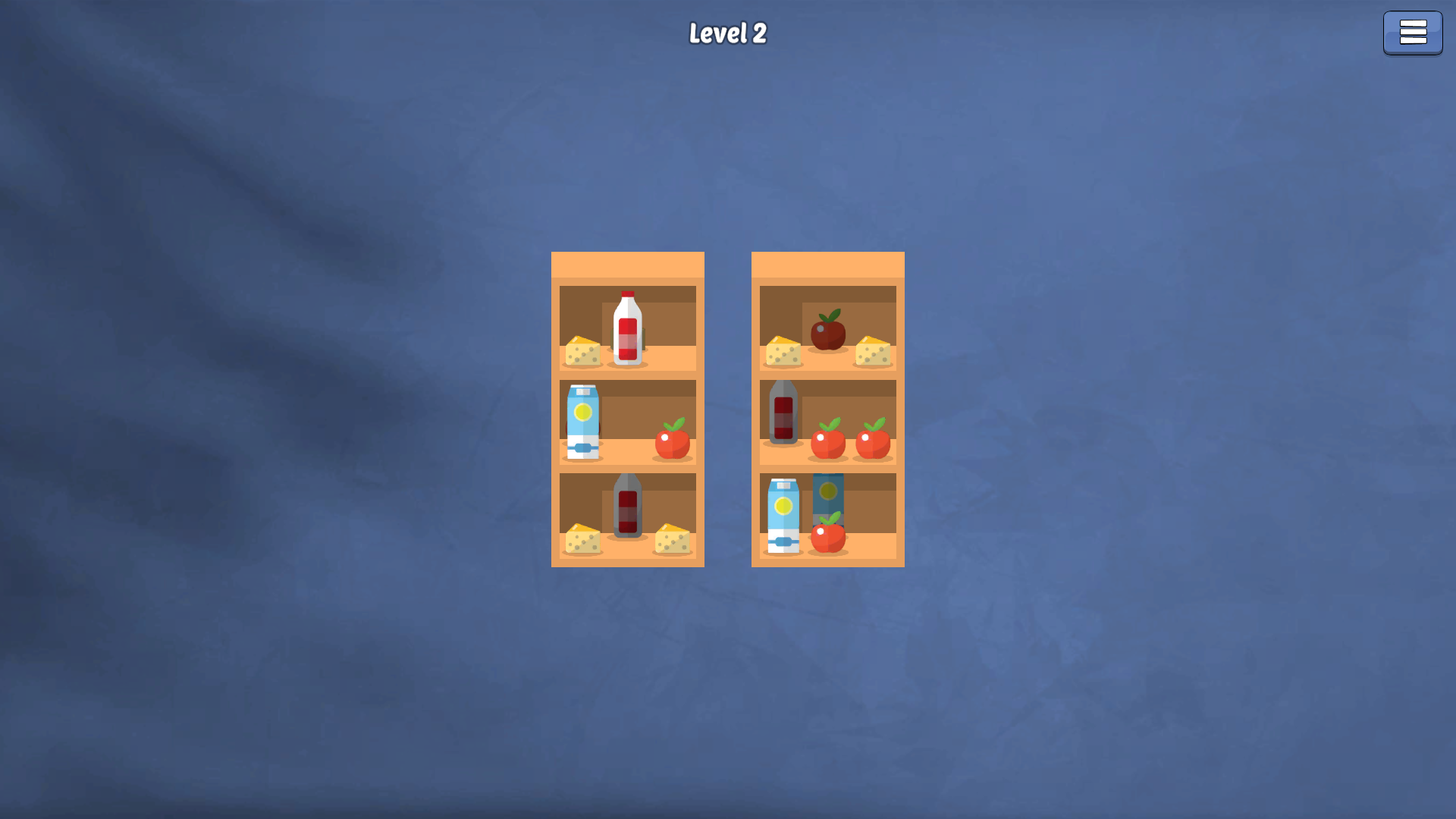
Level 2 immediately widened the decision surface. Two tall shelf units created six compartments, and the board mixed cheese, milk, apples, red bottles, and the newly unlocked cartons. Some objects sat in front of others, including a green carton partly hidden behind an apple on the lower-right shelf. The rule had not changed, but visibility and spare capacity now mattered more.
That is where Good Sort Master begins to look like more than a one-screen matching toy. A front object can block your view of what is behind it, and moving it may reveal the third copy needed for a later clear. The safest habit is to scan every compartment before dragging, identify at least one complete set, and preserve an empty destination whenever possible. Clearing the first available triple is not always as useful as clearing the triple that opens the most shelf space.
Touch Feels More Natural, but Desktop Is Fully Playable
I completed equivalent Level 1 loops with a 1920 by 1080 desktop viewport and an emulated iPhone 13 touch viewport that saved native 1170 by 2532 screenshots. Both accepted the same route and produced the same result. On the wide desktop screen, the shelf occupied only a small part of a large blue background. The art remained readable, but the mouse traveled farther relative to the size of the puzzle.
In the portrait touch layout, the board filled much more of the available width and dragging an object directly with a finger-sized touch point felt closer to the game's physical sorting idea. Based on input and layout alone, touch is my preferred way to play. Desktop remains a good option if you want precise mouse placement or do not want to use a phone; this comparison does not make claims about real-device performance.
Good Sort Master is a strong fit for players who enjoy calm organization puzzles, triple matching, and short levels with visible progress. It is less convincing for someone seeking a timer, a demanding move limit, or an immediate strategic punishment for inefficient play. My first level was forgiving, clear, and satisfying rather than difficult. The promise lies in the later shelves, where more item types and partial occlusion can turn simple tidying into genuine space management.