The Clean Desktop Run Opened with Yellow-Green, Then Grape
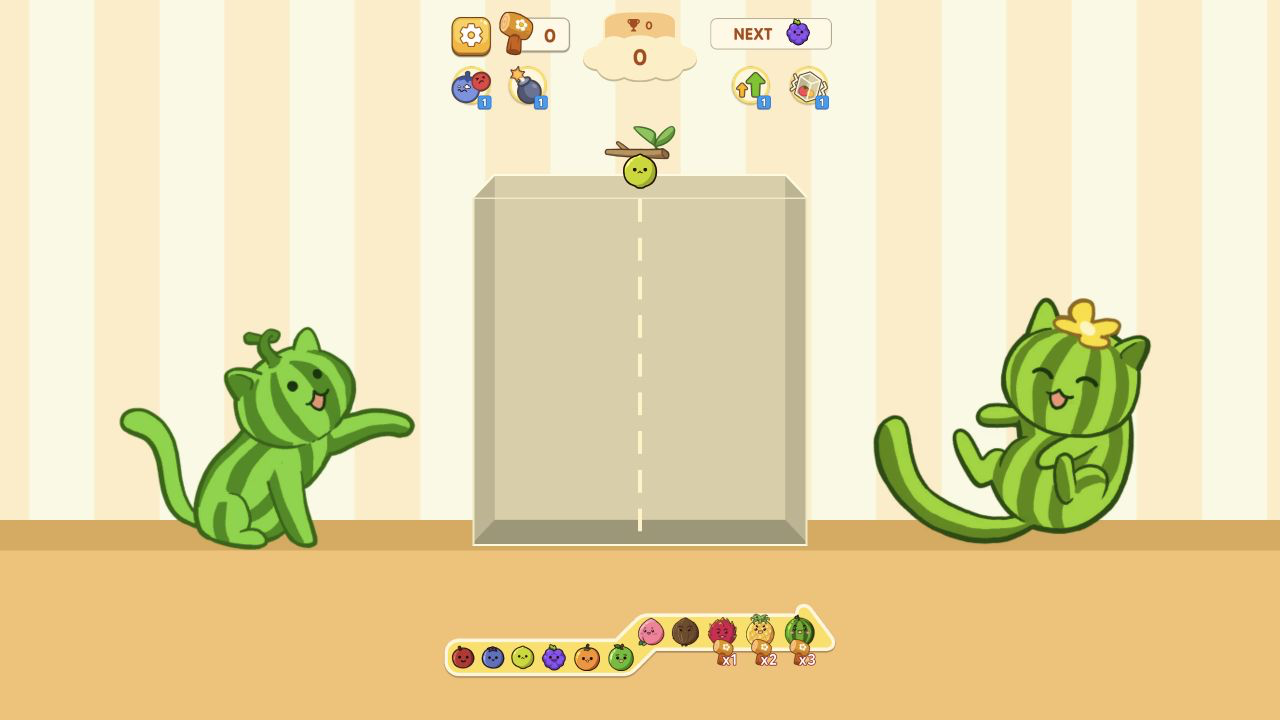
My desktop round began at 0 with a small yellow-green fruit on the branch and a grape cluster in the NEXT box. The container was empty, the dashed guide ran down its center, and the strip beneath it showed red, blue, yellow-green, grape, orange, and round green fruit leading toward Peach, Coconut, Dragon Fruit, pineapple, and watermelon. The goal was instantly clear: combine matching pieces while keeping the growing pile below the red limit.
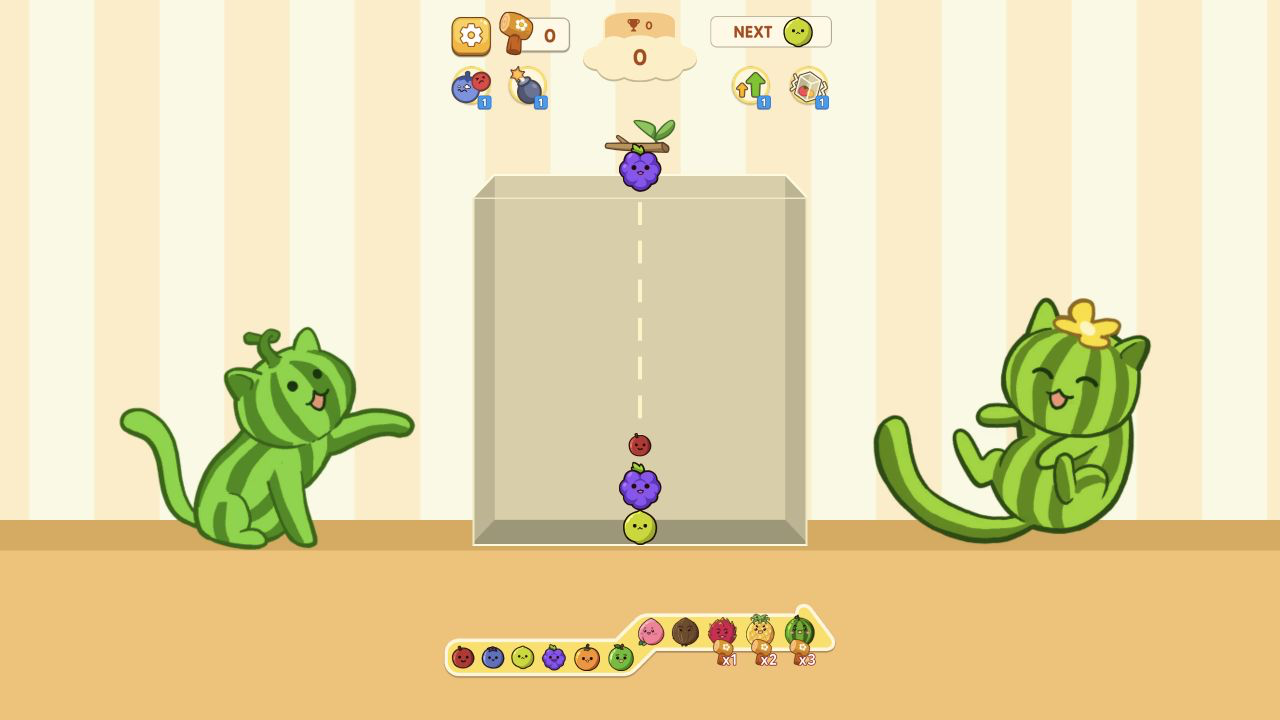
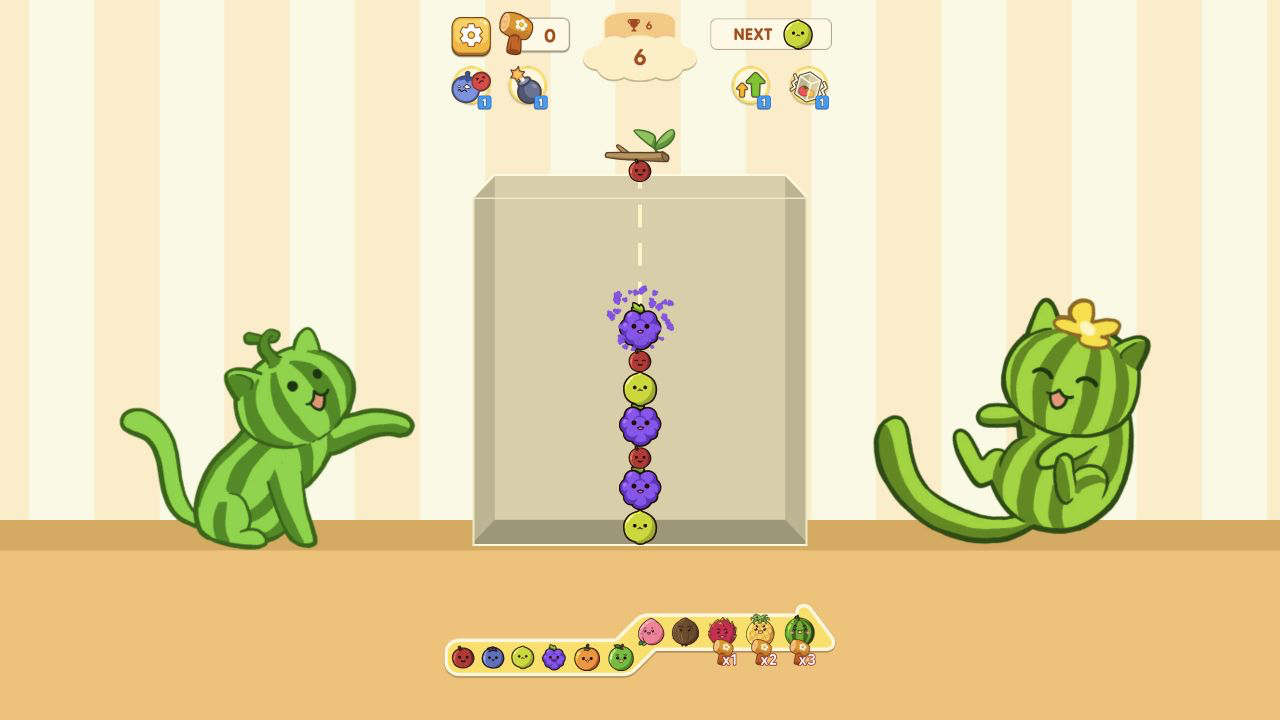
The yellow-green piece landed in the middle of the floor. Grape followed above it, then a red berry. None of those first three releases scored. The more important problem was their shape: they formed a straight central spine while generous space sat unused on both sides. On the wide desktop player, that wasted width was impossible to miss.
NEXT is useful, but it is only one-fruit planning. I could see what was coming and decide whether to wait for the stack to stop moving, yet I could not plan a long sequence. The practical opening rule from this run is therefore modest: do not rush the next release just because the current fruit has reached the floor. A half-second of settling can decide whether a new piece stays on the spine or rolls off a shoulder.
Mouse Aiming Kept Feeding the Same Center Chute
I moved the pointer left and clicked, but the branch did not shift. I then dragged the current fruit toward the left side before releasing; the red piece still fell on the dashed center line. On desktop, the mouse effectively behaved as a release button rather than a dependable tool for choosing a lane.
That limitation makes timing more important than it first appears. If every fruit enters through the same chute, the only way to gain width is through collision, rolling, and the shape of the pieces already below. Rapid clicks deny the physics time to help. A tall symmetrical column is especially dangerous because the next fruit has no sloped surface that can redirect it.
Mobile gave me more control. At 364 points, the branch and dashed guide sat clearly to the right while an orange waited above the pile. That extra placement freedom helped the fruit spread across the floor instead of feeding one permanent tower. Touch felt quicker for choosing a side; desktop remained easier for reading NEXT and the warning line.
One Purple Collision Moved the Desktop Score from 0 to 6
The counter stayed at 0 through the opening drops, then changed to 6 as purple particles burst around the upper grape. Once the pieces settled, an orange was visible near the top of the pile. That was the desktop round's only scoring sequence. The game never explained how those six points were calculated, but the visible grape contact and resulting orange made the merge itself easy to follow.
The merge looked helpful for a moment because it removed overlapping small pieces. It did not solve the underlying shape. Yellow-green fruit, red berries, and grapes remained arranged almost perfectly vertically, and the new orange was wider than the pieces that created the collision. This is Fruit Merge's core tension: a successful match reduces the count of objects but can create a larger object in the worst possible place.
Watching NEXT before each release was still worthwhile. When the preview repeated a fruit already near the top, I could wait until that piece stopped wobbling and improve the chance of contact. What I could not do on desktop was reserve a safe side lane. The best strategy available in this run was patient sequencing, not pixel-perfect aim.
At 6 Points, Empty Width Could Not Save the Rising Column
The red horizontal line appeared while the score was still 6. An orange sat near the top, with grapes, red berries, and yellow-green pieces stacked underneath. Most of the container remained empty, but that space was irrelevant because the active column had reached the danger zone. A few releases later I could see two oranges separated by a red berry, plus more grapes above the rim. The pile was no longer merely untidy; it was mechanically unrecoverable without a fast merge.
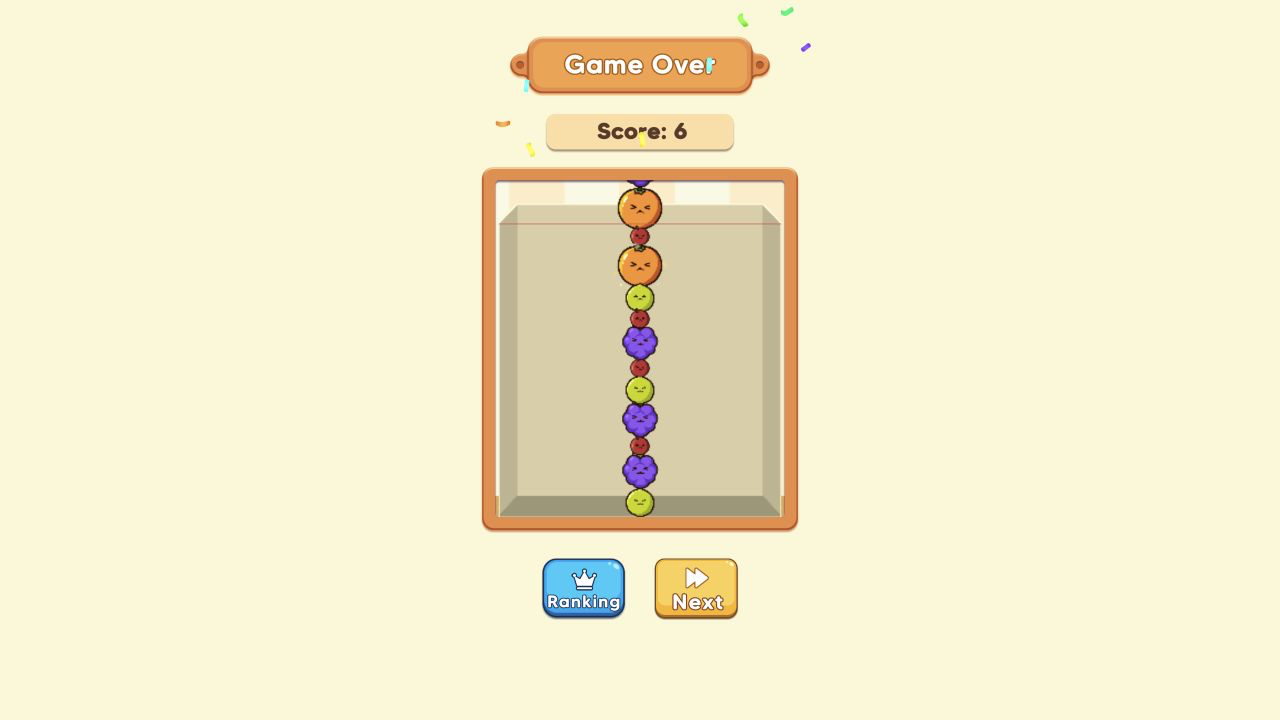
My key desktop mistake was pace. Once the column reached half height, I continued releasing instead of waiting for every wobble to end. The game does not fail the instant a piece touches the line. It allows the physics to settle, which creates a short rescue window, but I filled that window with more weight. The final Game Over panel reported exactly 6 and preserved a miniature view of the entire tower, so the cause was unambiguous.
The mobile board at 364 had the opposite geometry. Three Peaches, several oranges, green fruit, grape clusters, and smaller red, blue, and yellow-green pieces covered the floor. It was crowded, but its shoulders and gaps still gave new fruit somewhere to roll. The gulf between 6 and 364 showed how valuable that usable width had become.

Mobile Reached Peach at 175 and Coconut at 606
On mobile, Play opened a portrait fullscreen player with Playflaming's back control at the upper left. The first named milestone appeared at 175: YOU REACHED PEACH. Pressing Continue triggered a short Take a break countdown, then returned me to the same board instead of wiping out the pile.
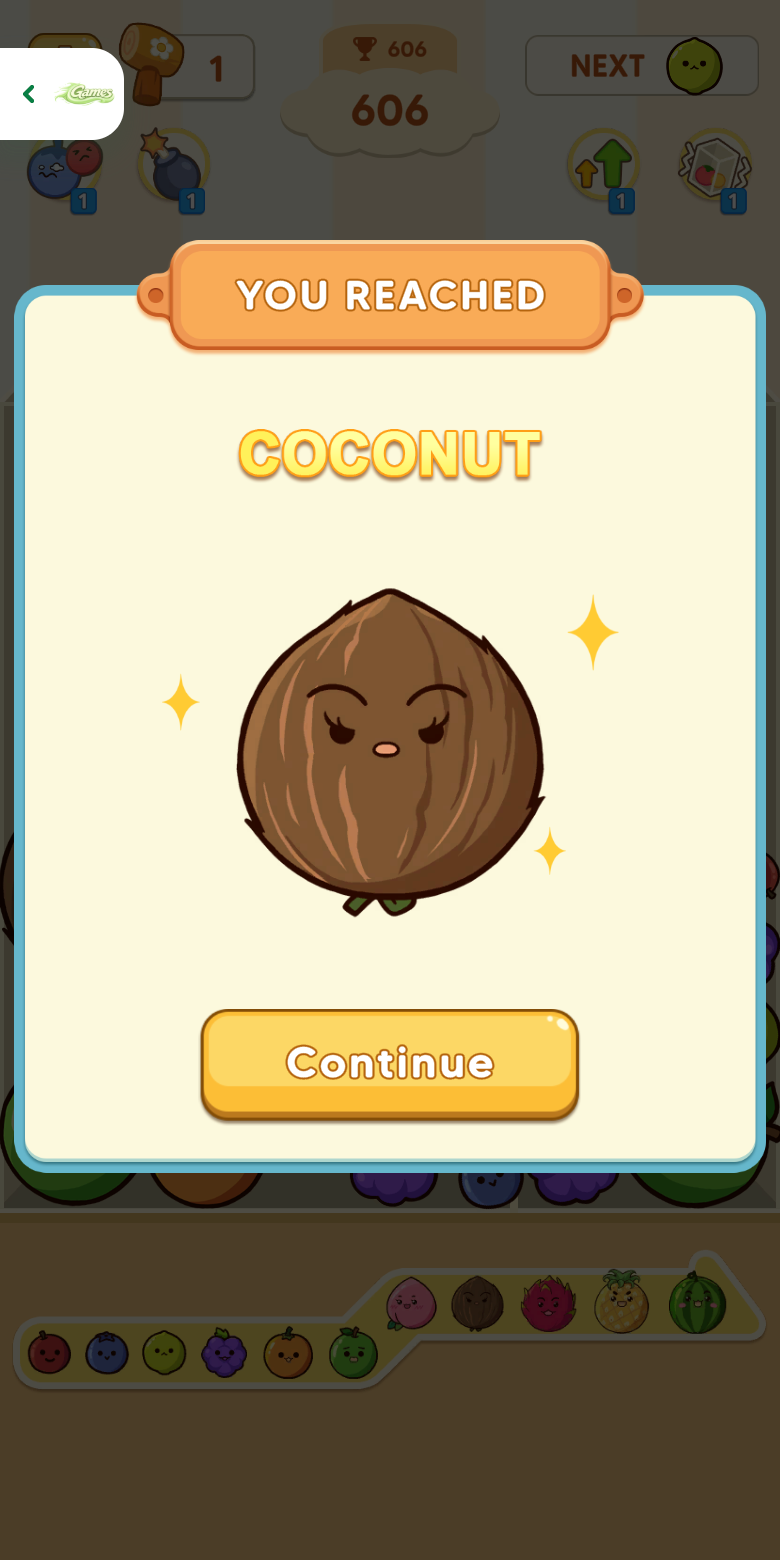
At 364 I had three visible Peaches. The next milestone was YOU REACHED COCONUT at 606, and continuing revealed two Coconuts alongside a Peach and smaller fruit. Peach to Coconut was the meaningful chain in this run; the later icons on the progression strip remained goals rather than guarantees.
Touch was quicker and more useful for lane selection. The orange waiting over the 364-point board sat to the right rather than the middle, and the pile occupied the full floor. Mouse offered a wider view of NEXT and the warning line, but it did not give me the same placement control. For these runs, mobile was better for aiming while desktop was easier to inspect.
Dragon Fruit Arrived at 1,152; the Score Later Reached 1,168
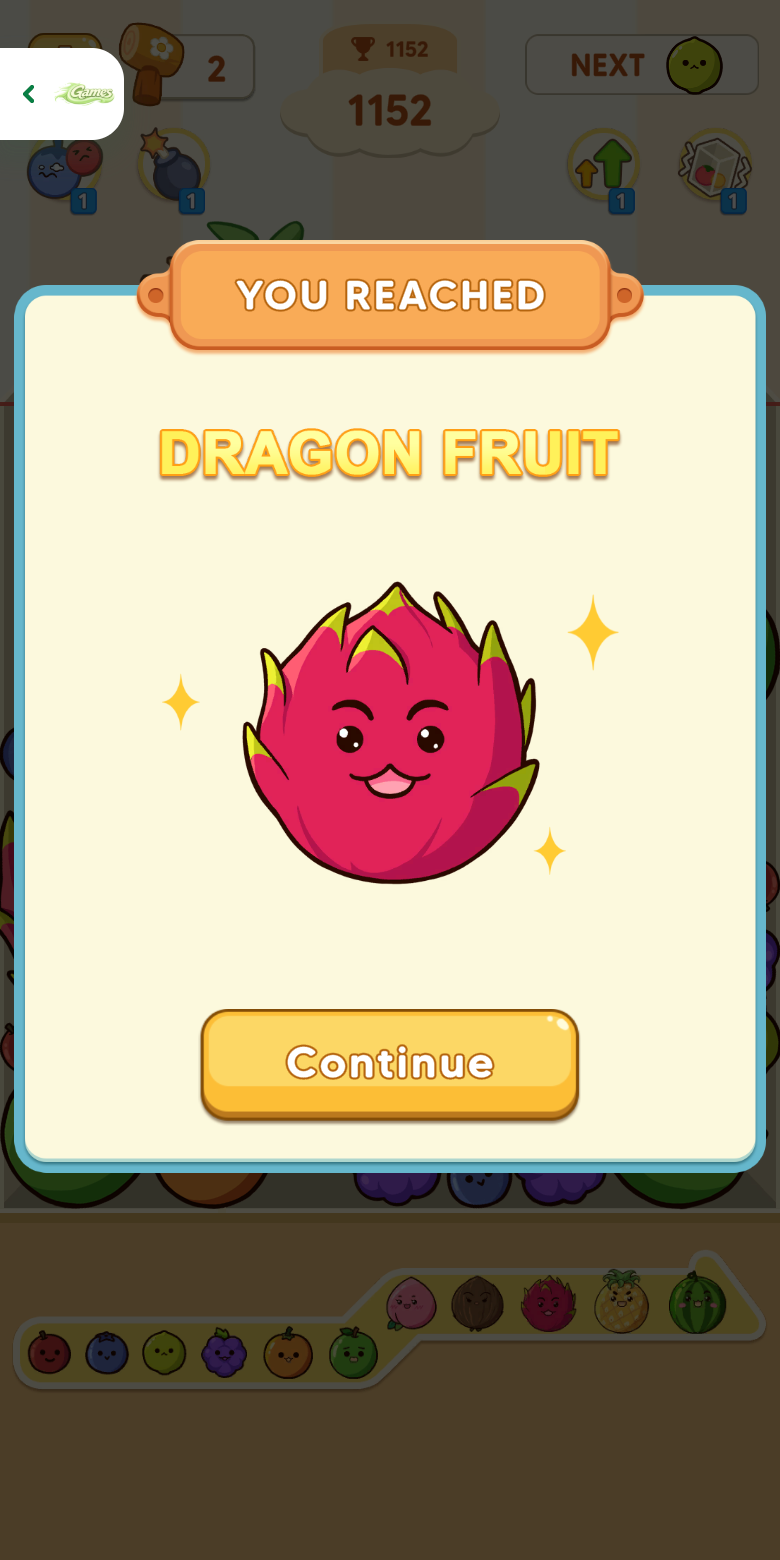
After Coconut, the mobile score moved through 624, 716, 757, 792, 898, 959, and 1,080 before the next named milestone. At 1,152 the game announced YOU REACHED DRAGON FRUIT with a large pink Dragon Fruit and a Continue button. I never reached pineapple or watermelon. Continue pushed the counter to 1,168, and that was where the run stopped.
This was not a normal overflow. After another Take a break countdown, the player became a blank white area while the audio continued, and no result panel appeared. I therefore treat 1,168 as the final score from this run, not a completed Game Over result.
Restarting the desktop round took more than one tap. The 6-point result offered Ranking and Next, but Next returned to the home scene with a Daily Rewards panel and a Claim button. I had to close that panel and press Play before the empty container returned. The route back is understandable once learned, although a direct Retry button would better suit such short rounds.
The run I most want to replay is desktop, because 6 is such a correctable failure. I would slow the cadence, release only after the top fruit settles, and use any naturally sloped shoulder to push the next piece away from the center. On mobile, the target is simpler: preserve two low landing zones after Coconut and see whether Dragon Fruit can form without the board becoming a solid wall. Fruit Merge is at its best when a crowded pile suddenly collapses into one larger fruit, immediately opening space for the next decision.