Twenty bathroom objects, one completed episode
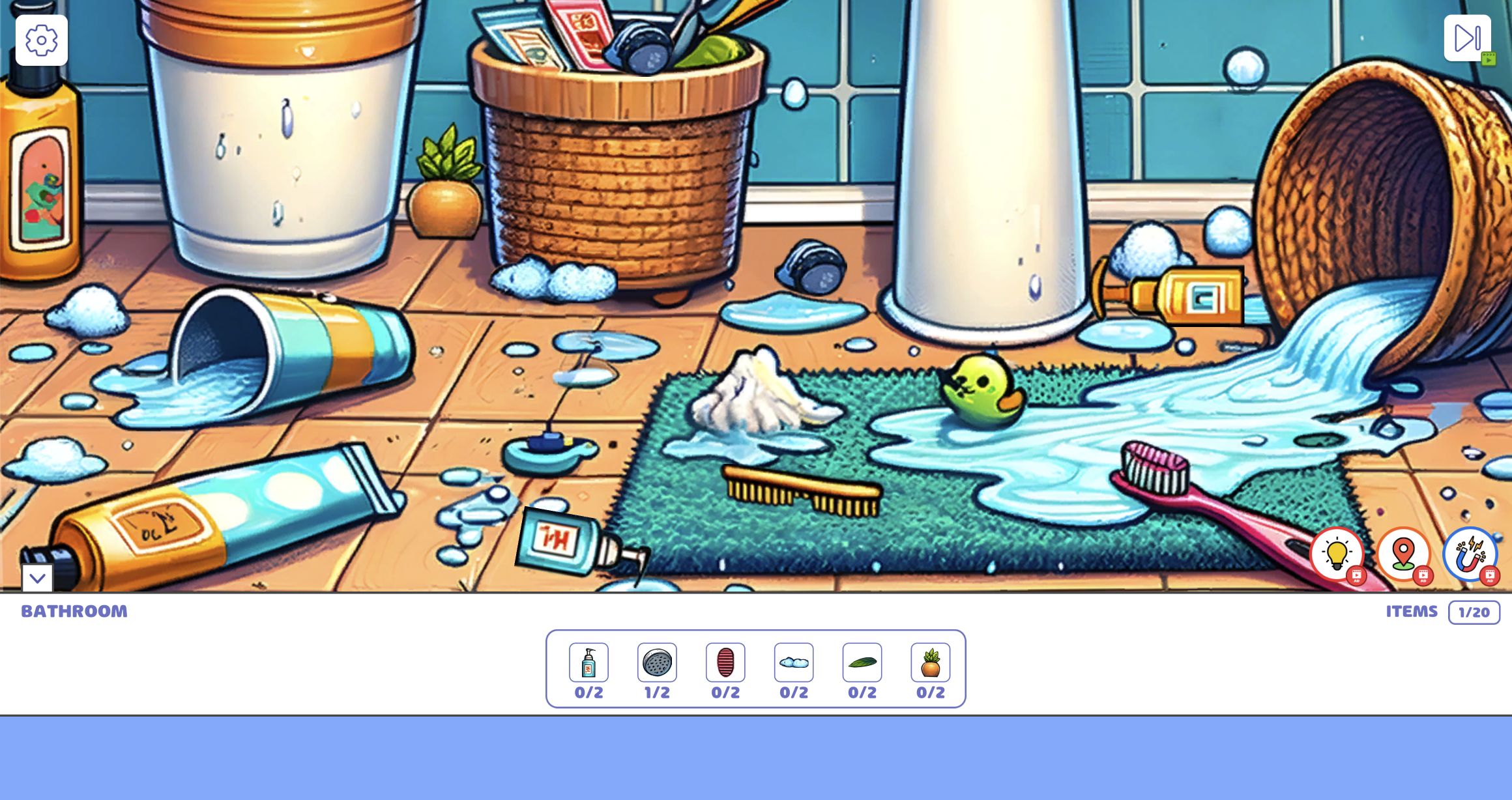
My Find Out Hidden Object session began with a brush lying in plain sight and ended with an orange pump bottle camouflaged on a shelf. Between those two taps, the Bathroom episode asked for 20 objects hidden across a wonderfully untidy cartoon scene: a cat splashing in a sink, toppled baskets, spilled water, towels, plants, toiletries, foam, and a rug full of visual decoys. I completed that desktop episode from its tutorial prompt to the 20/20 confetti burst and the Level Complete card. I did not press Next Episode, so this review stays with the room I actually finished.
The strongest part of the game is how readable that one simple goal remains. A counter at the lower right tracks total progress, while a strip below the room shows the remaining object types in pairs. At 15/20, my list had been reduced to six partially completed categories, and the room still looked busy enough to conceal the final five. There was no visible timer during this episode, and my incorrect taps did not change the counter or produce an obvious strike. The pressure came from observation, not a clock or punishment system.

The tutorial teaches the whole loop in two sentences
The Bathroom tutorial is admirably brief. It darkens the room, circles a circular perforated showerhead, and says Tap on item to pick it up. Once collected, a second message tells you to find every item on the list to complete the episode. That is almost the entire ruleset. There are no character statistics, inventories, dialogue trees, or crafting menus between the player and the picture. The first successful tap moves the counter to 1/20 and rearranges the item strip so unfinished categories remain relevant.
The paired-category format is more interesting than a conventional checklist of unique silhouettes. One dark pump bottle can be obvious near the floor, while its partner is tucked onto an upper shelf. A blue rolled item may sit among foam in a basket, then reappear near a different spill. Completing a pair adds a check mark and shifts the strip, which keeps the remaining search compact even as the room changes camera position. It also creates useful partial victories: finding one of two tells you exactly what visual shape to keep in mind. Because the icon remains visible until both copies are found, the list acts as a memory aid without spelling out a location or turning the search into a text-heavy task.

The best hiding places borrow the room's visual language
Find Out Hidden Object works best when a target belongs naturally to its surroundings. A brush can double as detail on the cat's ear or hang on the wall like an ordinary grooming tool. Leaf shapes disappear into the broad foliage of a potted plant. Pineapple-like silhouettes masquerade as tiny decorative planters, while blue rolls blend with bubbles, towels, and scattered debris. These are not invisible pixel specks; they are recognizable forms placed where your brain is willing to dismiss them as scenery.
The Bathroom illustration helps by being playful without becoming muddy. Turquoise wall tiles separate foreground props cleanly, orange pots and wicker baskets anchor the warmer shapes, and white water or foam creates high-contrast pockets. The scene is larger than the visible desktop window, so the camera moves between clusters rather than presenting one static poster. That movement adds a light spatial-memory layer: after inspecting the cat and sink, I had to remember which floor corner held a basket and which shelf contained bottles. The repeated water droplets and blue tile seams are especially effective decoys because their outlines resemble several listed items without feeling randomly pasted over the art.

Hints are precise, but their advertising cost is hard to ignore
Three helper buttons sit at the lower right: a lightbulb, a map-pin-style icon, and a magnet. Each carried a red video badge in my session. I tested the lightbulb repeatedly. When granted, it did exactly what a stuck player needs: the room darkened, the camera panned and zoomed to one remaining target, and a bright circular spotlight marked the object. The game did not collect it automatically; I still had to recognize the highlighted shape and tap it.
The tradeoff is interruption. Hint requests repeatedly opened rewarded ads, including Playgama interstitials and creatives with timed Skip, Close Ad, or Close Ad × controls. On mobile, one return sequence required Skip, then Close Ad, then Click to keep playing before the target appeared. I never clicked an ad body or external call to action. Because I used hints heavily to verify every object, my ad exposure was probably higher than a confident player solving unaided, but the tested fact remains: frequent hint use can make the final stretch feel less like a continuous search.

Portrait mobile makes the room bigger and the route narrower
Playflaming's 390x844 fullscreen dialog was a natural home for this vertical game. The visible Exit game control and the absence of the underlying recommendation grid confirmed that the captures came from the modal, not a cropped page card. At 0/20, the cat, sink, helper buttons, counter, and six current item categories all fit in one clean portrait frame. Objects were physically larger than in the wide desktop embed, so direct tapping felt accurate and the illustrated details were easier to inspect.
The cost is context. Desktop exposes a broad horizontal slice of the room and gives the item strip plenty of breathing room. Mobile often centers one shelf, plant, or floor cluster, requiring the camera to pan before another region becomes available. That is not a poor fit—the catalog itself declares a vertical orientation—but it changes the skill from scanning a panorama to remembering a route through close-ups. I completed the full 20/20 Bathroom loop with real taps and hint returns on mobile, then reached the same LEVEL COMPLETE — BATHROOM card as on desktop.

A satisfying search, if you can resist leaning on the lightbulb
The Level Complete card is simple but earned: it names Bathroom, shows a thumbnail of the cleared room, and offers Next Episode. There was no score, star rating, timer bonus, or accuracy grade on this result, so the reward was closure rather than optimization. That suits the episode's relaxed structure. It also means replay motivation will depend on later pictures or self-imposed no-hint runs, neither of which I tested beyond the visible Next Episode invitation.
Find Out Hidden Object is an easy recommendation for players who enjoy careful visual scanning, cozy clutter, and targets that hide through shape association rather than microscopic trickery. Desktop is best for seeing more of the room at once; portrait mobile is best for larger individual details. The main reservation is the ad-backed helper system. Solve independently and the Bathroom has a pleasant, uninterrupted rhythm. Reach for the lightbulb repeatedly and the exact same clever camouflage is separated by waiting screens. My ideal way to play would be slowly, with hints saved for the final one or two objects.
