Nigel Turned My First Computer Match into a Tactical Mess
My first Chess Online Multiplayer computer game lasted 18 moves and ended by resignation. I played White as Guest with a displayed rating of 100 against Nigel, also rated 100. The game began quietly with 1.e4 e6, then became strange almost immediately: Nigel moved the same knight from g8 to f6, on to h5, and later back toward f4 while I built a broad center. By the end I had promoted a pawn, captured Nigel's queen, thrown away my own queen with check, and surrendered after the king took it.
That chaotic arc is a better description of the game than its generic menu. The board is large and clear, selected squares receive a green highlight, and the side panel records every move in algebraic notation. Undo, Hint, Shop, Rules and Give up sit beside the log. I never had to guess whether a move registered, and the position remained readable even when pieces began disappearing quickly.
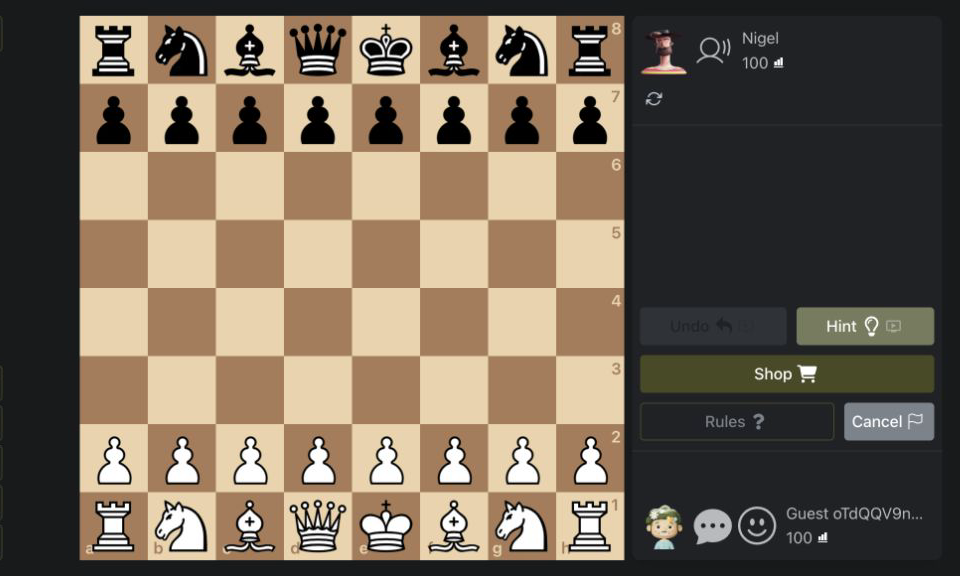
The French-Style Opening Gave Me a Comfortable Center
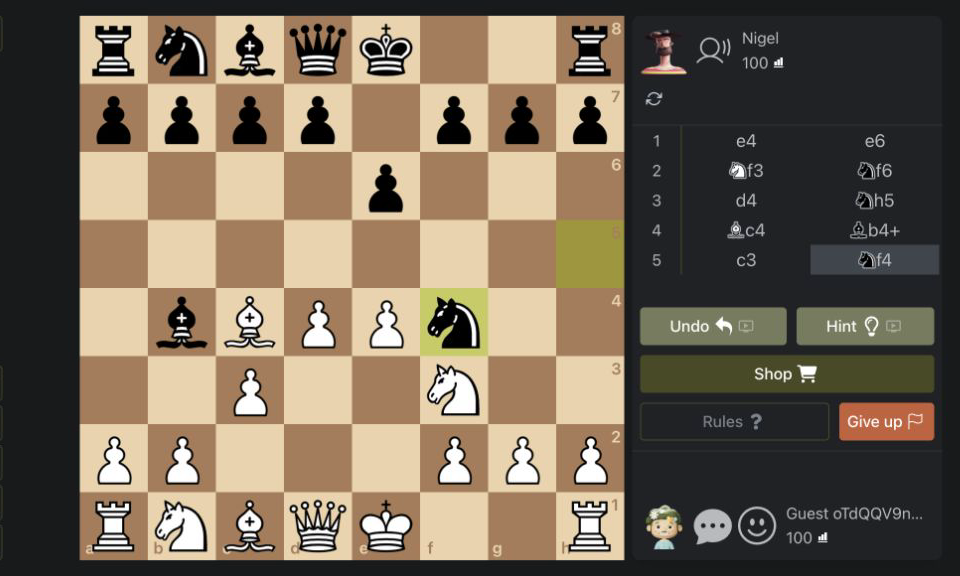
I followed 1.e4 e6 with 2.Nf3 Nf6 and 3.d4. Nigel's 3...Nh5 spent another tempo on the same knight, so 4.Bc4 felt natural: develop, aim at f7, and prepare to castle. The move list made this opening easy to audit, while the current move remained highlighted. It is a practical interface for casual players because the board and notation reinforce each other without demanding a separate analysis screen.
The caution is that a weak-looking computer sequence can tempt careless aggression. Nigel's 4...Bb4+ forced an answer before I could continue attacking. I played 5.c3, blocking the diagonal with a pawn and asking the bishop to decide. The computer did not retreat it; instead, 5...Nf4 increased pressure elsewhere. That refusal to follow a tidy opening script is what made the low-rated opponent entertaining.

Blocking Check with c3 Created an Unbalanced Position
After the check, I chose 6.Bxf4 and removed the wandering knight. Nigel replied 6...b6, and I pushed 7.e5 to chase the remaining f6 knight position and gain space. The center then opened rapidly: 7...f6 8.exf6 Bb7 9.f7+ Kf8. My e-pawn had transformed into a protected passer on f7, one square from promotion, while Nigel's king had already lost castling rights.
This stretch demonstrates the value of the visible history panel. In a messy position it was easy to confirm exactly how the pawn arrived on f7 and why the king moved. The interface also shows captured-piece icons under the board. Those details turn a casual browser game into something you can reconstruct after a mistake, even before opening the separate Game analysis option.
Castling Did Not Remove the Danger
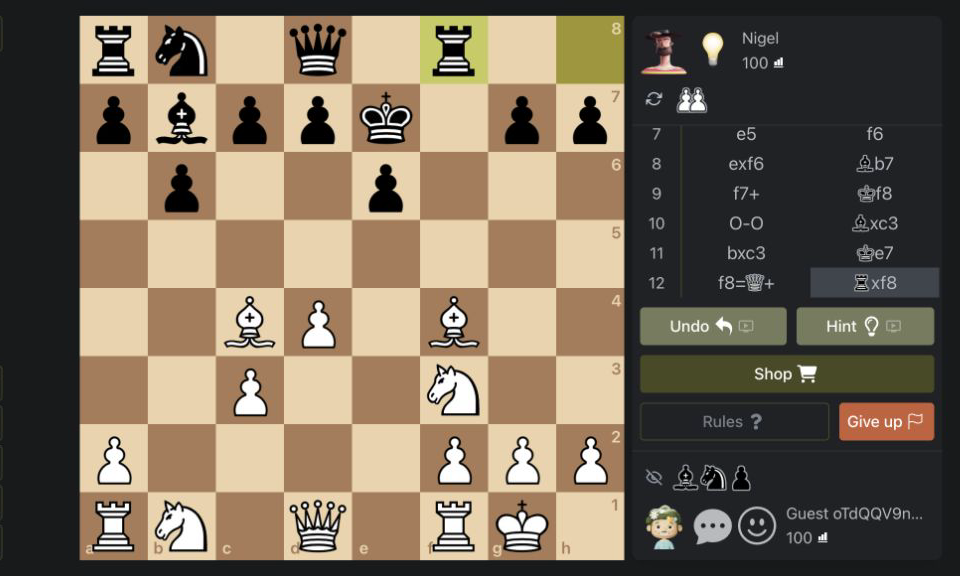
I castled with 10.O-O, which put my king behind three pawns and connected the rook to the center. Nigel answered 10...Bxc3, taking the pawn that had blocked the earlier check. I recaptured 11.bxc3, and 11...Ke7 walked the black king toward the center. The position looked favorable for White: I was one move from promoting with check, my bishops were active, and Nigel's king and queenside pieces were awkward.
The board presentation helped here. Light and dark squares have enough contrast without overpowering the pieces, and the last move highlight is visible at a glance. The side panel is dense but logically grouped. The surrounding provider page displayed recommendation tiles on desktop, so the evidence images are cropped without upscaling to the native 960-by-576 player area, where the board, move history and controls remain readable.

My f-Pawn Promoted and Vanished on the Same Move
Move 12 produced the session's most dramatic moment. I played 12.f8=Q+, and a promotion chooser offered queen, rook, knight and bishop. I selected the queen. Nigel's rook captured it at once with 12...Rxf8. The promotion was not a free material windfall; it traded a pawn for a rook while forcing check and drawing a defender onto f8.
The game handled the special move cleanly. The selection panel appeared immediately, the notation used the standard equals sign, and the new piece was resolved without animation getting in the way. This is also where a casual player can learn an important lesson: reaching the back rank is only part of promotion. Before choosing the obvious queen, check whether the destination square is defended and what exchange follows.
I Won Nigel's Queen, Then Gave Mine Away
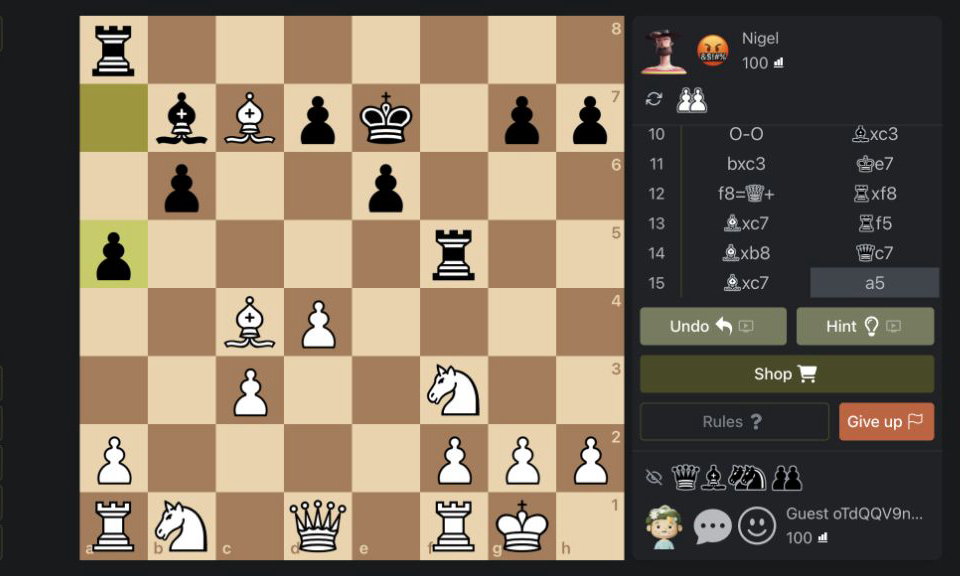
I kept the initiative with 13.Bxc7 Rf5 and 14.Bxb8. Nigel then played 14...Qc7, placing the queen where my bishop could take it. I accepted with 15.Bxc7. At that point the captured-piece strip showed a remarkable haul, and Nigel's angry face icon fit the position. After 15...a5, 16.Qb3 Ke8 and 17.Qb5 Rf4, I should have slowed down and consolidated.
Instead I played 18.Qxd7+? The check looked forcing, but Nigel's king simply captured the queen with 18...Kxd7. That was my decisive error. I tested the Hint button earlier in the game, and it eventually drew arrows toward a suggested move, but only after triggering another Playgama advertisement. The initial game load also had a skippable preroll, and a short interruption appeared midgame. Hints are available, but in this session they were not frictionless.
Desktop Cost 50 Rating; Mobile Added One Star
After 18...Kxd7 I pressed Give up, confirmed the Finish the game dialog, and received Defeat. The result panel showed rating 100 minus 50 and stars zero plus 18. It offered Game analysis, Rematch, New Game, Shop, Leaders, Chat and Menu. Resigning was the honest finish: I had completed a full computer match and reached a recorded result, even if my earlier queen capture made the loss especially painful.
I ran two touch checks through the local Playflaming fullscreen modal at 390 by 844. The first was deliberately short: as Black against Lambert Hades, I answered a central pawn move, watched the opponent develop a bishop, then used the flag dialog and confirmed resignation. That terminal result kept my rating at 50, displayed minus zero, and added one star to 18.
The second mobile run gave the controls a longer test against jocose hottabych. Across eight Black turns I played ...e5, ...Nf6, ...Nc6, ...Bc5, ...d6, ...O-O, ...h6 and ...a6. Piece selection, target squares and legal kingside castling all registered by touch while the opponent developed its own position. I stopped that run after recording the castled midgame rather than inventing a result; the earlier resignation remains the only mobile terminal screen.
The portrait board and tap targets were usable in emulation, and the flipped coordinates made Black's perspective clear through a substantive opening. That supports mobile layout and touch-input claims, not claims about real-phone speed, heat, battery or network behavior. I did not test a human online opponent or activate any purchase. The largest friction in these sessions was advertising around loading and the Hint action.
