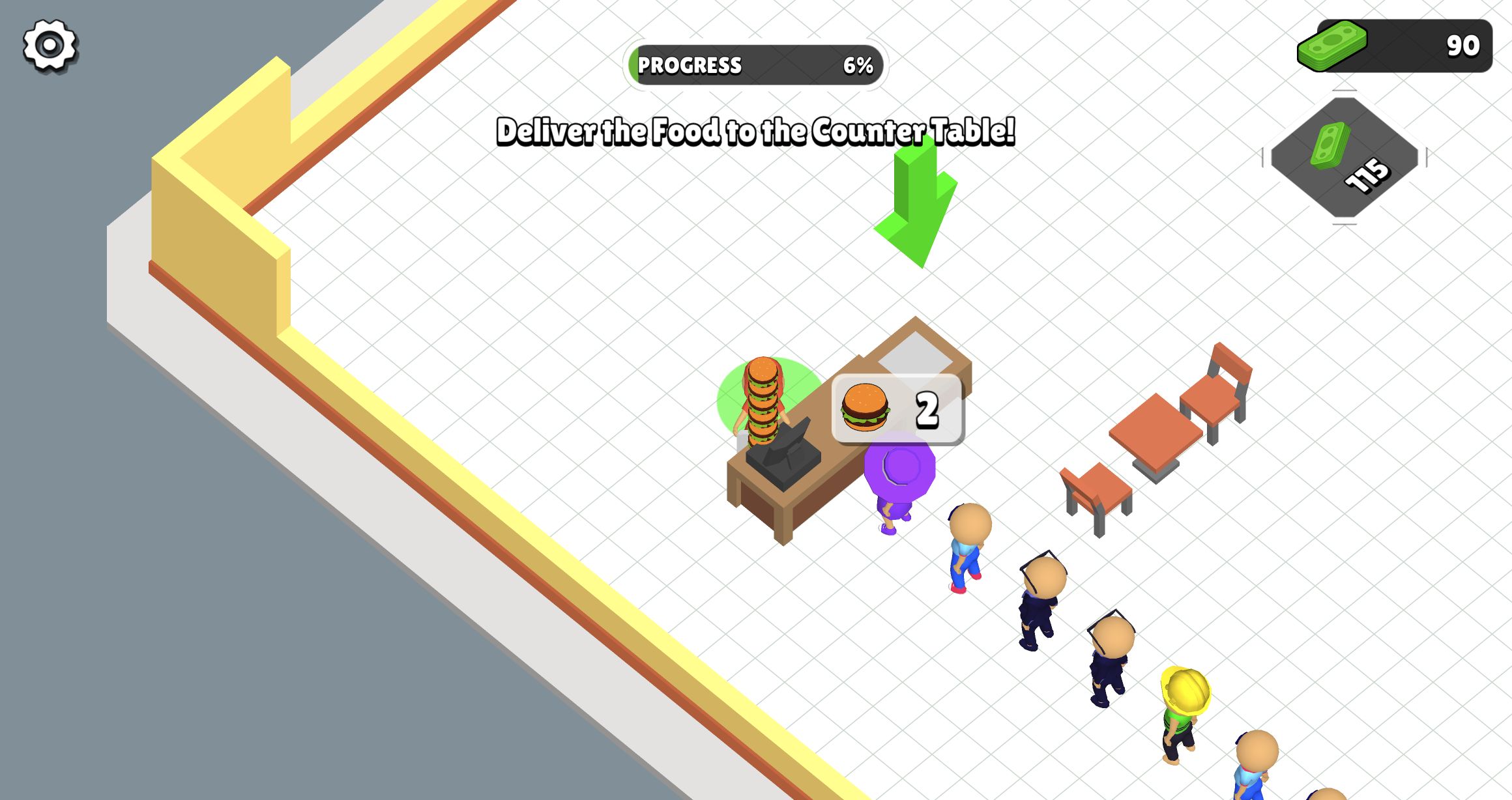
My First Restaurant Stopped at 6%, Not at a Grand Opening
My first Burger Life shift began with $400, an empty white-tiled room, and a progress bar at 0%. It ended at 6% with a counter full of burgers, one occupied table, $120 in the register, and a line of customers stretching across the restaurant. That is a small slice of the game, but it was enough to expose the central loop: spend cash on a usable floor plan, carry stock to the service point, collect income, free the seat, and keep the line moving.
The session did not reach a finished day, an expanded dining room, or a staffed business. I entered the room marked HR but did not hire anyone, so I cannot judge automation, employee costs, or later management depth. This review is deliberately about the first operating cycle—the point where an empty room becomes a functioning but obviously constrained burger shop.
What surprised me was how physical the management feels. Menus did not magically convert money into service. My character had to walk to each highlighted purchase spot, fetch the prepared burgers, carry them to the counter, and later remove the dirty plates. The numbers are simple; the route between them creates the work.

Three Purchases Turned $400 into a Working, Bare-Bones Shop
The tutorial's spending sequence was clear and expensive enough to matter. The first table cost $100, changing the balance from $400 to $300 and progress from 0% to 2%. Confetti marked the purchase, then the instruction switched to Add a Counter Table. That counter cost another $100, leaving $200 and raising progress to 4%.
The burger machine was the final required investment. Installing it cost $110, so only $90 remained when progress reached 6%. In total, the opening equipment consumed $310 before the first customer payment. The game never asked me to compare alternative layouts or prices in this stretch; the arrows prescribed the build. Even so, watching the cash fall made the order of operations understandable: there is no revenue until the dining seat, counter, and production station all exist.
The weakness of that starter plan is visible immediately. One table can serve only one diner at a time. The opening purchases create a working restaurant, not a comfortable one, and the queue soon proved that the difference matters.

The Burger Machine Produced Six Meals I Had to Carry Myself
After the machine appeared, the next prompt was Pick up 6 Burgers. A tray beside the grill held a neat stack, and reaching it transferred six burgers into the character's hands. The stack stayed visible while I crossed the floor. That small animation is important because it proves that production and service are separate tasks. Buying the machine does not keep the counter stocked automatically.
The fresh desktop run reached the same 6% state with $90 and completed the six-burger pickup in the direct 2320 by 1228 game viewport. Keyboard movement made the long crossing direct: walk to the grill, collect six, and head back toward the counter. On mobile, drag movement also worked, but one long gesture was not enough to traverse the whole room consistently. I had to repeat drags and correct the path, which made distance more noticeable than the purchase taps themselves.
For a beginner, the practical lesson is to finish one route cleanly. Pick up the full stack when prompted and go straight to the counter instead of detouring into HR or circling the room. Early efficiency is mostly walking efficiency.

The Counter Route Started Service, but Not Seating
In the completed mobile loop, reaching the counter deposited the carried burgers into another visible stack and changed the instruction to Serve the Customers. The first people stepped forward with order bubbles showing a burger icon and the number 2. Income followed in small, readable jumps: the balance rose from $90 to $100, then to $120 as service progressed. The fresh desktop run independently verified the same build costs and six-burger carry, then stopped while approaching the counter rather than overstating a second completed service cycle.
The counter interaction is mostly automatic once stock and a customer meet, so the interesting decision shifts elsewhere. A long line formed in both the desktop embed and the mobile fullscreen run. Food was available, yet one table could not absorb the demand. The game had turned the initial build order into a bottleneck without needing a detailed capacity screen.
I would not call the early economy balanced from two payments, and I did not test how much later furniture costs. What the session does prove is narrower: a stocked counter earns money, and that income does not solve slow seat turnover by itself.

NO SEAT Was the Most Useful Warning in the Lunch Rush
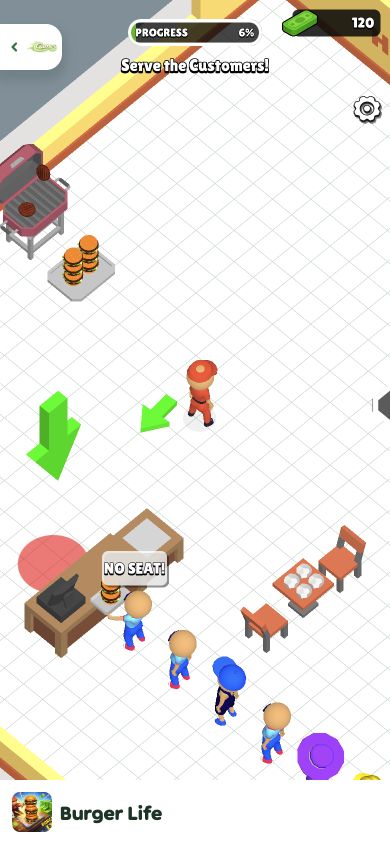
The clearest management feedback was not the progress bar. It was a customer bubble that said NO SEAT. One diner had occupied the starter table, several more customers were still near the counter, and the table eventually held a tray of used dishes. The warning connected the queue to a specific cause: the shop did not need more burgers at that moment; it needed its only seat back.
That distinction kept the early loop from feeling like a pure idle number climb. Production, service, seating, and cleanup can block one another. A player who camps beside the grill may keep food ready while allowing the dining area to stall. The smarter beginner route is to watch the table after a customer sits, then move toward it as the meal ends.
The mobile portrait view actually helped with this particular diagnosis because the counter, table, queue, NO SEAT bubble, progress bar, and $120 balance fit in one tall frame. That supports a layout observation, not a claim that a physical phone would run better.
Payment Was Not the End: Dirty Plates Had to Reach TRASH
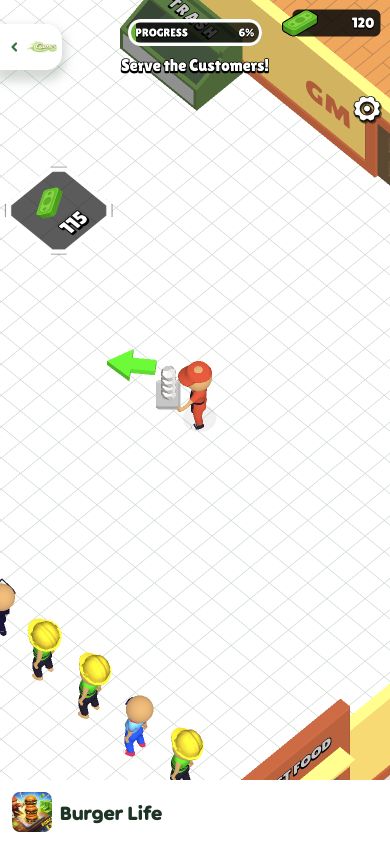
When the diner finished, the table did not reset invisibly. I approached it, picked up a stack of dirty gray plates, and carried that stack across the room to the green bin marked TRASH. The plates disappeared only after reaching the bin. Clearing them completed the most representative part of the session because it returned the single table toward useful service instead of ending the story at the cash increase.
Cleanup also explains why movement friction matters. On touch, several repeated drags were needed for a long trip. On desktop, keyboard assistance made the same kind of crossing more direct. Both control routes were usable for this early loop, and mobile completed the real Playflaming fullscreen path at 390 by 844, but desktop is the more comfortable choice for repeated travel around the restaurant based on the tested inputs.
I briefly entered the HR room after the service work. No employee was hired, so the session offers no evidence about staff automation or whether later upgrades reduce the carrying burden. The visible room is a promise of another system, not proof that I tested it.
A Promising Manual Management Loop with an Honest 6% Boundary
Burger Life is best suited to players who enjoy watching a bare room become operational through small physical jobs. The early pleasure comes from concrete changes: a table appears, the counter takes shape, the grill produces a stack, customers pay, a seat blocks, and dirty plates disappear into the bin. Players looking for an idle restaurant that runs itself immediately may find the repeated walking deliberately slow.
For review methodology, the working Playgama export route was opened as a direct 2320 by 1228 desktop game viewport, and every desktop image used here is an untouched full-frame capture from that player. No detail page, browser chrome, or cropped game region is used. Mobile testing began from the local detail page's Play button, opened Playflaming's 390 by 844 fullscreen player with its Exit game control visible, and closed only the displayed Close Ad control before play. The mobile result confirms touch input and the early loop in browser emulation; it does not establish real-phone performance, battery use, or thermals.
My verified result is a 6% restaurant with $120 after buying the first table, counter, and burger machine; moving six burgers; serving customers; encountering NO SEAT; and disposing of the dirty dishes. That is enough to recommend a simple opening plan: follow the required build order, carry the full burger stack straight to the counter, watch the only table, and clear it before exploring HR. It is not enough to claim what Burger Life becomes later, and the review stops where the evidence stops.