Level 1 taught the bank shot before asking for speed
My first board opened with 65 bubbles to remove, 20 shots in the launcher, and only red, yellow, and blue in the hanging formation. The desktop tutorial said, “Drag to aim, release to shoot!” and drew a bright line from the yellow launcher bubble into the right wall. The mobile dialog added the useful sentence “Hit the same color balls!” Neither version buried the rule: attach to a matching group, and exploit the side wall when a straight route is blocked.
The launcher also showed the next bubble underneath the current one, so the board was not just a reaction test. I could plan the present angle while knowing which color would follow. Four power-up icons sat along the bottom, but I left all of them untouched in both runs. That matters because every score and cascade described here came from ordinary shots, not a bomb, color swap, or paid shortcut.

One yellow bank removed twenty-two bubbles at once
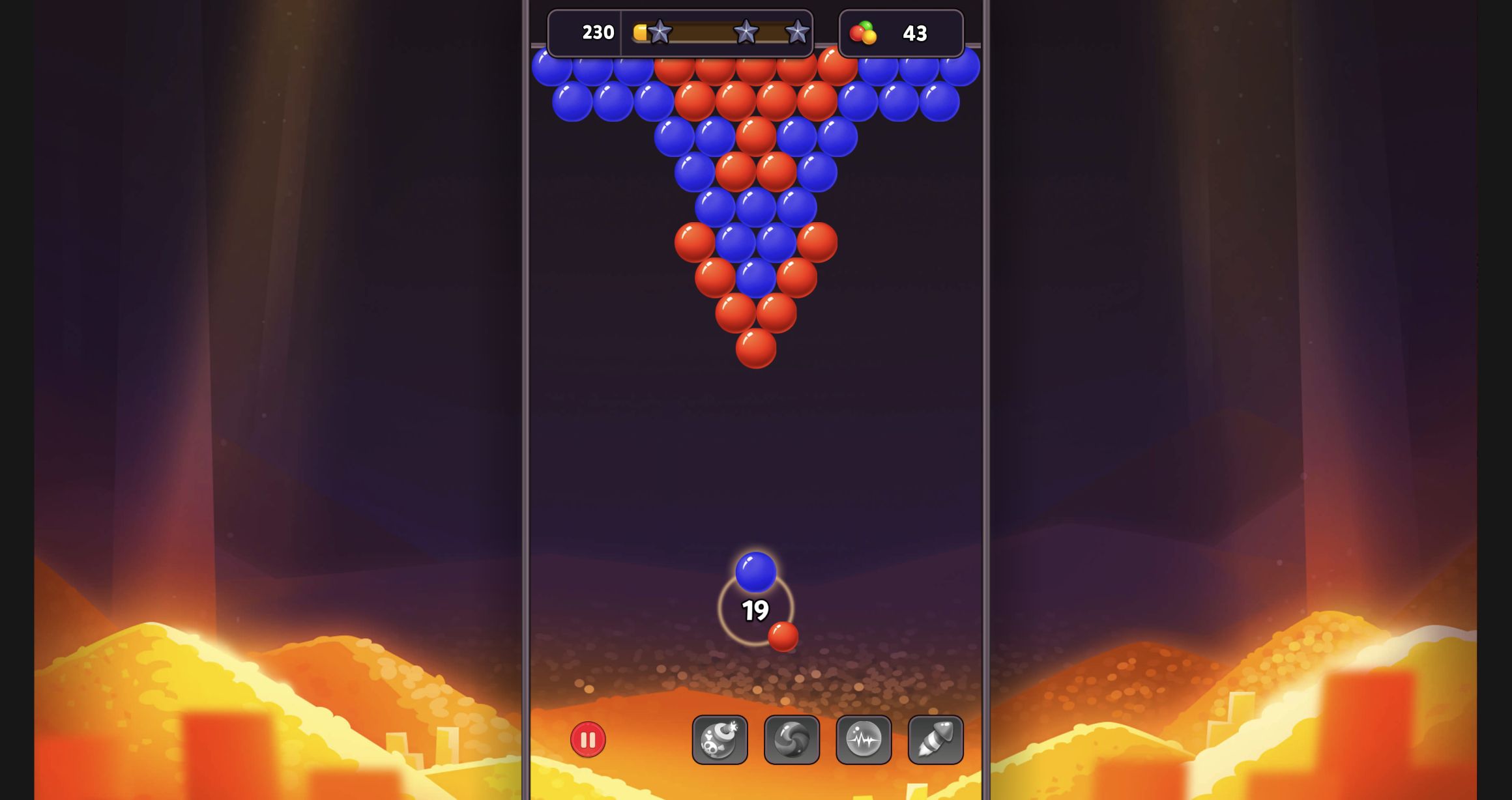
I sent the opening yellow into the left wall so the reflected guide reached the upper-left yellow support. The cascade reduced the target from 65 to 43, raised the score to 230, and left 19 shots. The match itself was only part of the reward; bubbles disconnected from the ceiling dropped too. This is the central tactical pleasure of Tap & Pop: aim at a structural support rather than the nearest convenient trio, and one bubble can clear a large hanging section.
I repeated that opener in the Playflaming mobile fullscreen player. The narrow screen still showed the complete reflected path from the launcher to the left wall and back into the yellow support, and the result again read target 43 with 19 shots. Touch did not make the line feel vague or jumpy; I could hold, adjust the angle, and release when the endpoint sat on the cluster. The fixed player footer shortened the surrounding field, but it did not cover the bank point or the launcher.
My second desktop decision was much worse. I pushed blue too directly into the center and failed to complete a useful group. The new bubble simply attached. The score remained 230, the shot display moved to 18, and—more painfully—the target rose from 43 to 44. The game does not cushion a poor placement by calling it a neutral miss. You have added another bubble that must eventually be removed. That visible setback made the later recovery more satisfying and produced the clearest beginner lesson from my run: if the guide does not end on a real match or a support you intend to cut, reconsider the angle before releasing.
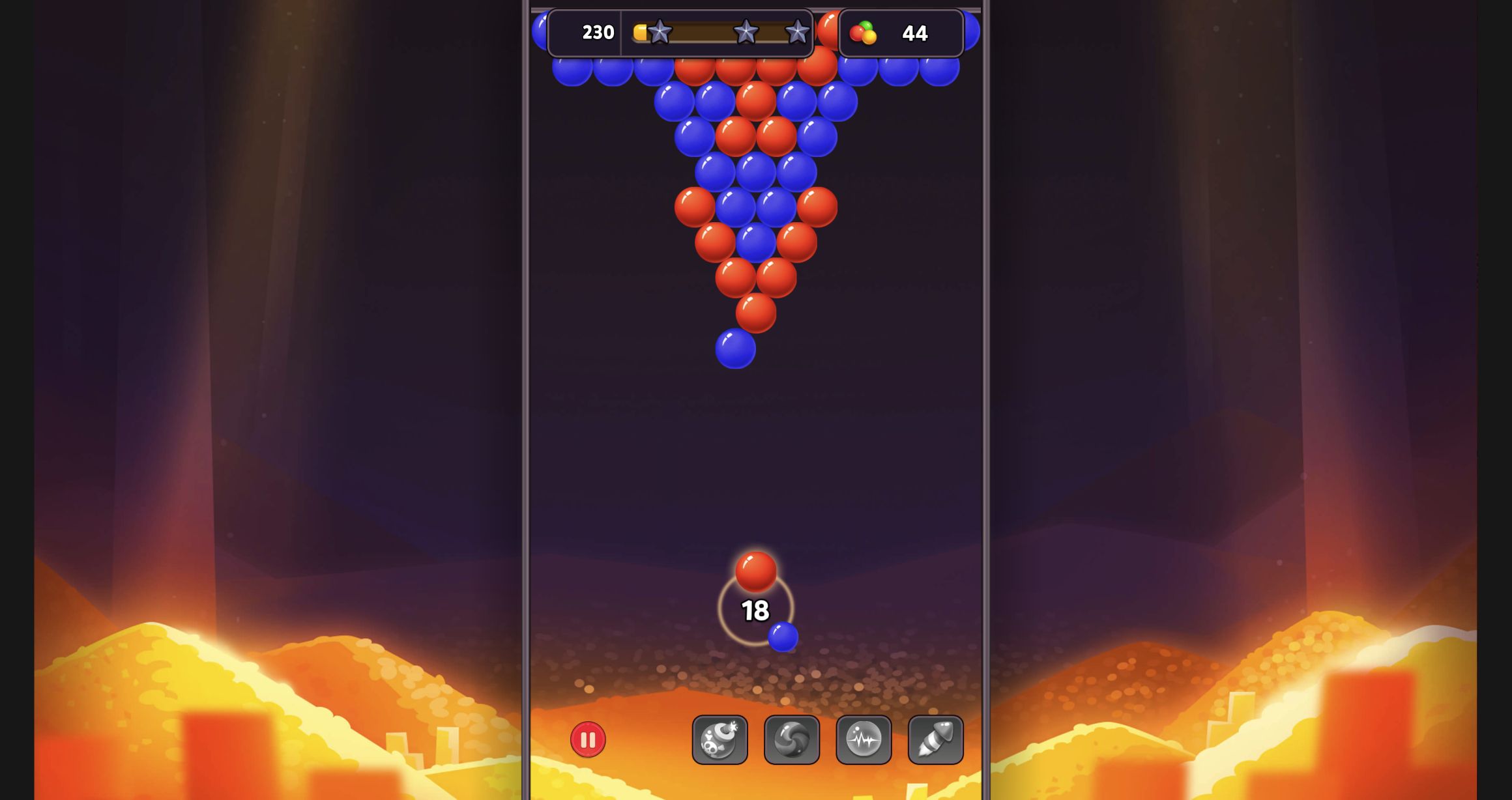
A simple red shot repaired some of the damage
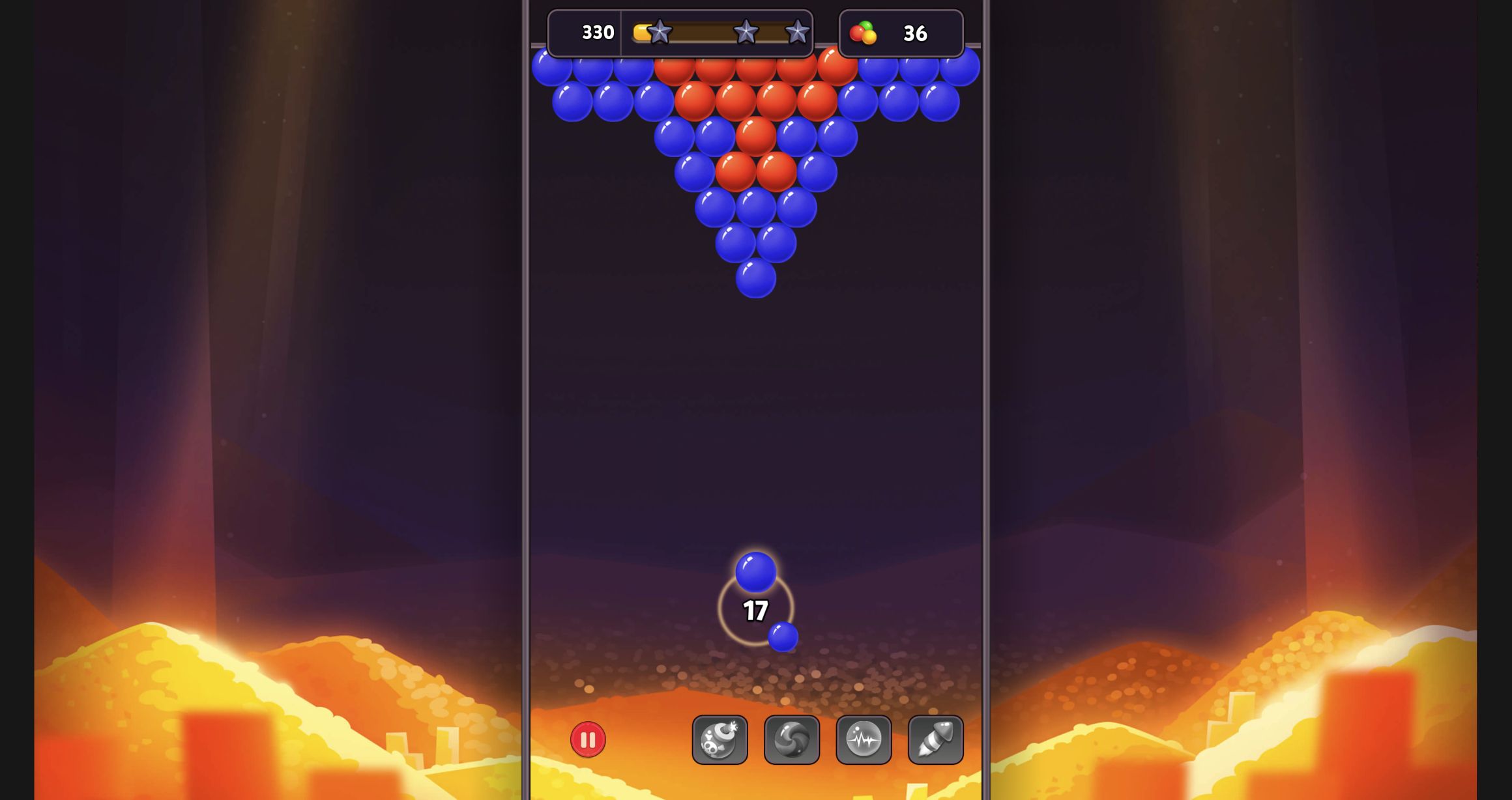
The next bubble was red, and this time there was no reason to be clever. I fired straight into an exposed red cluster. The target fell from 44 to 36, the score rose to 330, and 17 shots remained. That contrast is useful: wall banks create the dramatic drops, but a direct shot is better when the color already has a clean landing site. Trying to turn every move into a trick shot would only create more chances to reproduce my blue attachment.
Aiming felt crisp at the 2320 × 1228 desktop viewport. The game itself stayed in a narrow portrait board with large decorative margins, yet the reflected line was long and easy to read. Release committed the shot immediately, and cascades resolved quickly enough that I never wondered whether an input had registered. The wide presentation wastes space, but it does make precise mouse placement comfortable.
The second blue bank exposed the red finish
A later blue gave me a second chance to use the wall properly. This bank found the exposed support and removed nearly all of the remaining blue structure. On desktop, the board reached score 830 with target 12 and 16 shots. Only a compact red formation remained at the ceiling, turning the final decision into an obvious straight match. The star meter had begun filling, but the board was still the focus rather than a reward popup.
The mobile run reached this same twelve-red state more efficiently. After repeating the yellow left-wall opener, I banked blue off the right wall and watched the target fall from 43 to 12 with 18 shots left. Multiple 40-point labels trailed through the cascade. Because that blue landed cleanly and I never made the poor desktop attachment, mobile arrived here in two shots rather than four. That difference came from my decisions in the two sessions, not from different rules or a hidden touch advantage.

The final red triggered a noisy, generous clear
I sent the last desktop red straight into the remaining cluster. Target 12 became 0, and the board dissolved into loose colored bubbles, stars, sparkles, confetti, and repeated 500-point labels. The score showed 6720 during that animation before the result panel added the final tally. The display even offered “Click to skip animation,” but I let it run because the falling-bubble celebration is the payoff for setting up the support shots.
Mobile ended the same way with a third straight red. Target 12 dropped to 0, bonus labels filled the portrait field, and one shot was still displayed during the animation. The effect was busy but readable at 390 × 844. The tall board fits the phone-shaped viewport naturally, and touch drag-and-release responded as reliably as the mouse. The Playflaming fullscreen modal kept an Exit game control visible and a fixed footer below the player, slightly reducing the playfield height without covering the launcher, power-ups, or target counter.

Three stars on both screens, with a different score
The desktop Level 1 panel awarded three stars, a final score of 8720, and chest progress of 1/5. Mobile also earned three stars and 1/5 chest progress, but its cleaner three-shot route scored 9900. The desktop run took five shots from the initial 20-shot state because of my added blue and the recovery move. Those exact outcomes make the score difference understandable rather than mysterious: efficient support cuts preserved more of the board's available value.
There was some monetization friction around the mobile player. A visible ad appeared before the loop and was dismissed only with its Close control; I did not click its content. I also did not activate any power-up or optional monetization action, and no purchase checkout, login, chat, username, leaderboard, or multiplayer surface appeared during either Level 1 run. The catalog declares Android and Desktop support, and both tested environments were responsive. For this portrait game, the mobile layout uses space more naturally, while desktop gives the longest, clearest aiming guide. That is a layout preference based on emulation and desktop play, not a claim about real-phone performance, battery life, or network behavior.
This first level is best for players who enjoy finding one decisive support rather than matching every visible trio in sequence. The three-color board is immediately readable, mistakes have a concrete cost, and the star result makes efficiency matter without imposing a timer. The opening is easy to understand, but my 44-target setback shows that it still rewards a pause before release. If later levels preserve that balance between clear geometry and risky attachments, the compact loop has more tactical bite than its simple color palette initially suggests.
